Last Updated on 30/06/2026 by Bonnen Battery
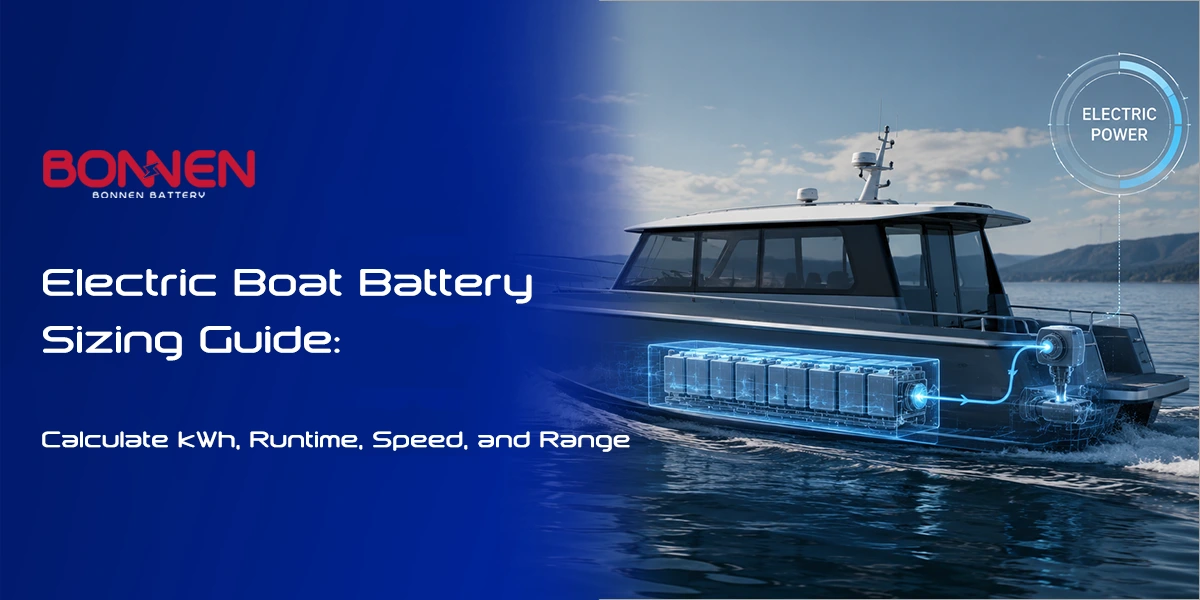
Calculate kWh, Runtime, Speed, and Range

Electric Boat Battery Sizing Guide: Calculate kWh, Runtime, Speed, and Range

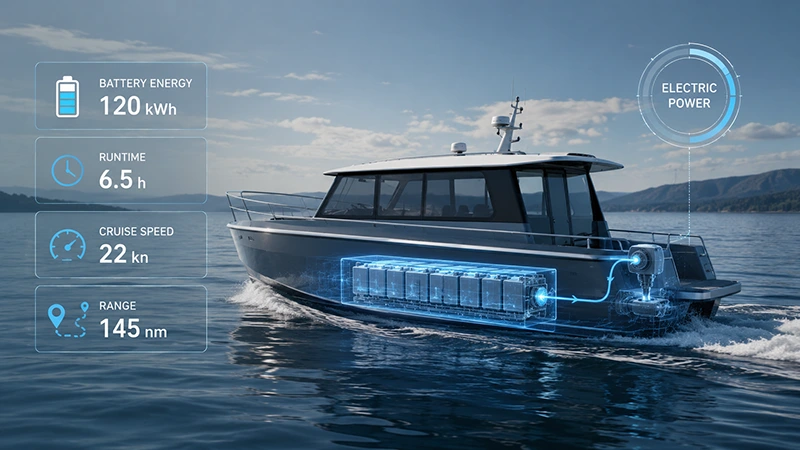
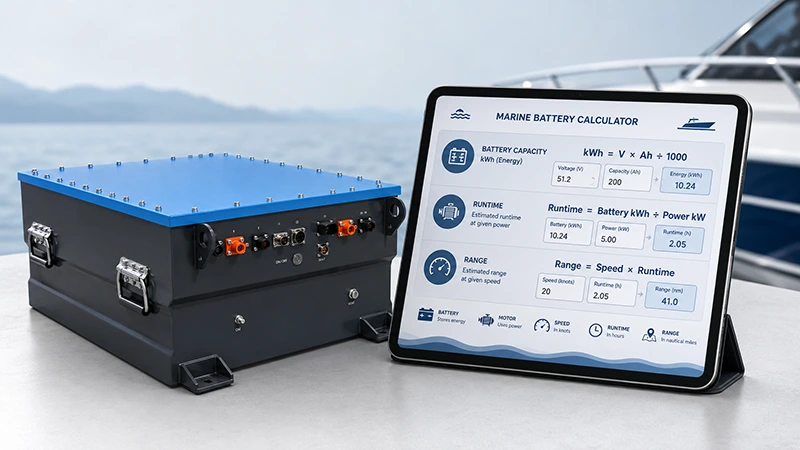
The right electric boat battery ⇱ size depends on four numbers: motor power in kW, usable battery capacity in kWh, average cruising speed, and the safety reserve you keep for wind, waves, payload, and battery aging. A simple rule is this: battery kWh = motor kW × target runtime ÷ usable depth of discharge. For most LiFePO4 marine battery projects, we normally size the system around 80–90% usable capacity, not 100%, because a marine battery should give reliable range, not just a nice number on paper.

For example, a 20kW electric outboard running at full power needs about 20kWh for one hour before adding reserve. If the system is designed around 80% usable capacity, the gross battery should be about 25kWh. In real cruising, the boat may use only 30–60% of peak motor power, so runtime can be much longer than full-throttle runtime.

Electric boat battery sizing is not only a math problem. It is also a boat problem. Hull type, speed, water conditions, total payload, propeller efficiency, motor controller current, BMS discharge rating, charger size, waterproof enclosure, and system voltage all affect the final battery design ⇱.

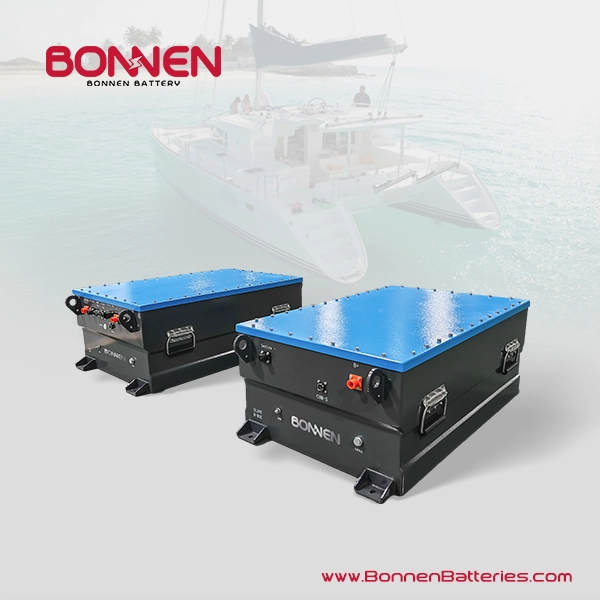
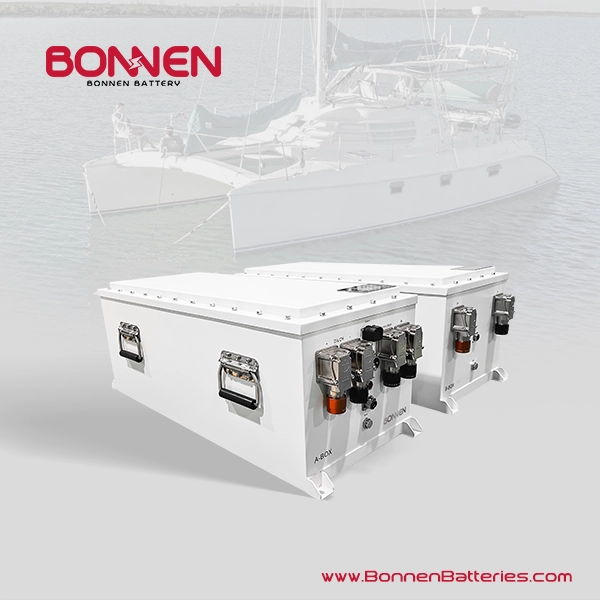
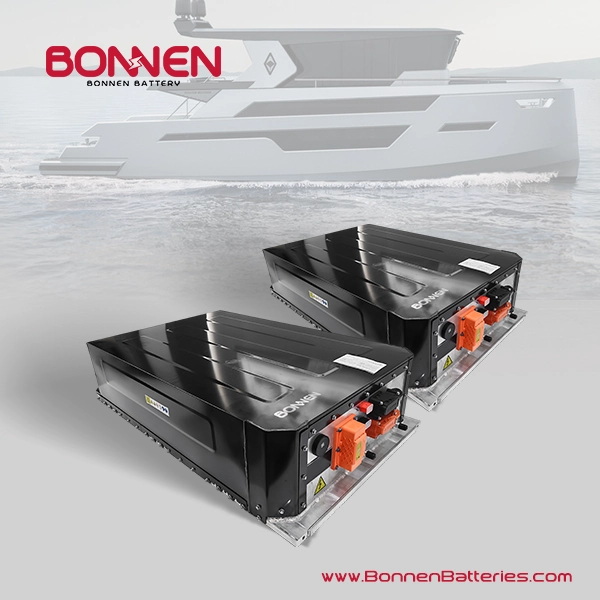
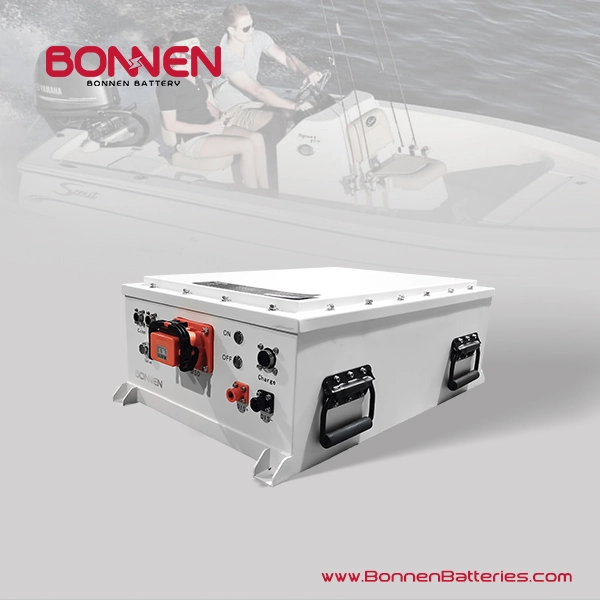
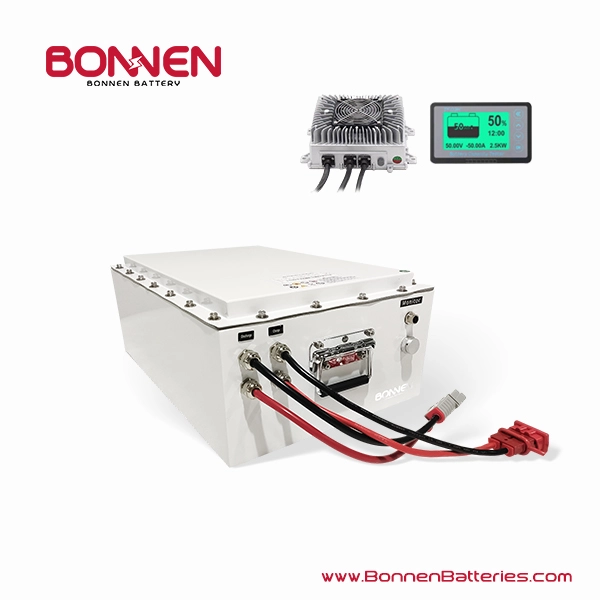
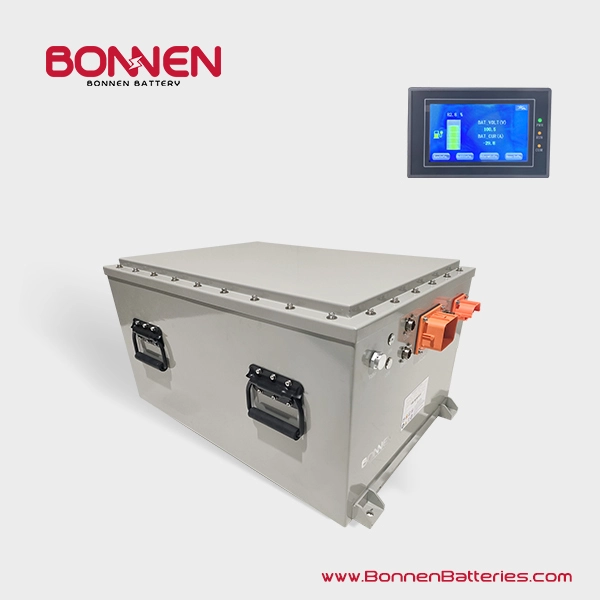
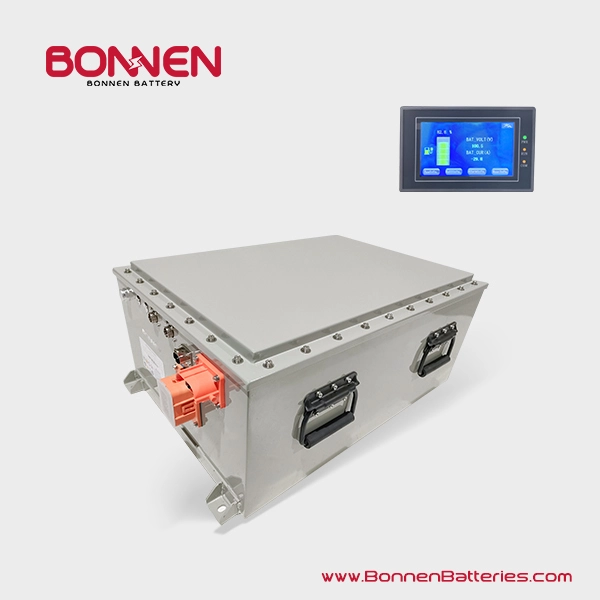
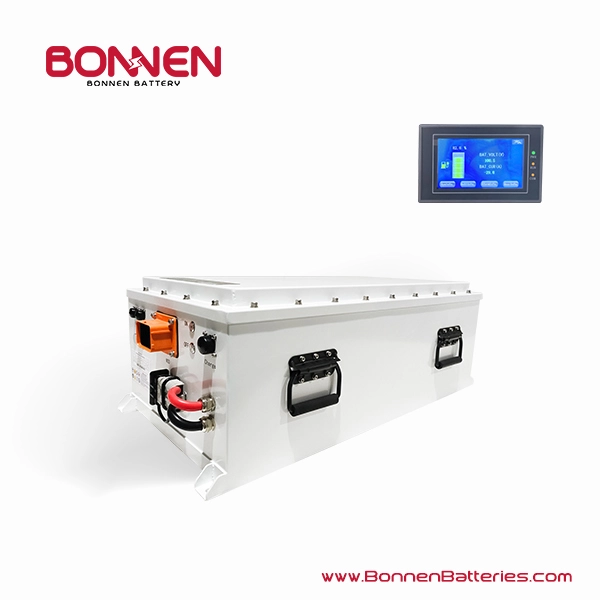
At Bonnen Battery, we design custom lithium battery packs for electric boats, electric outboards, canal boats, water taxis, catamarans, tenders, and commercial marine projects. This guide gives you a clear way to estimate your battery size before engineering starts.
1. Quick Answer: How Much Battery Capacity Does an Electric Boat Need?

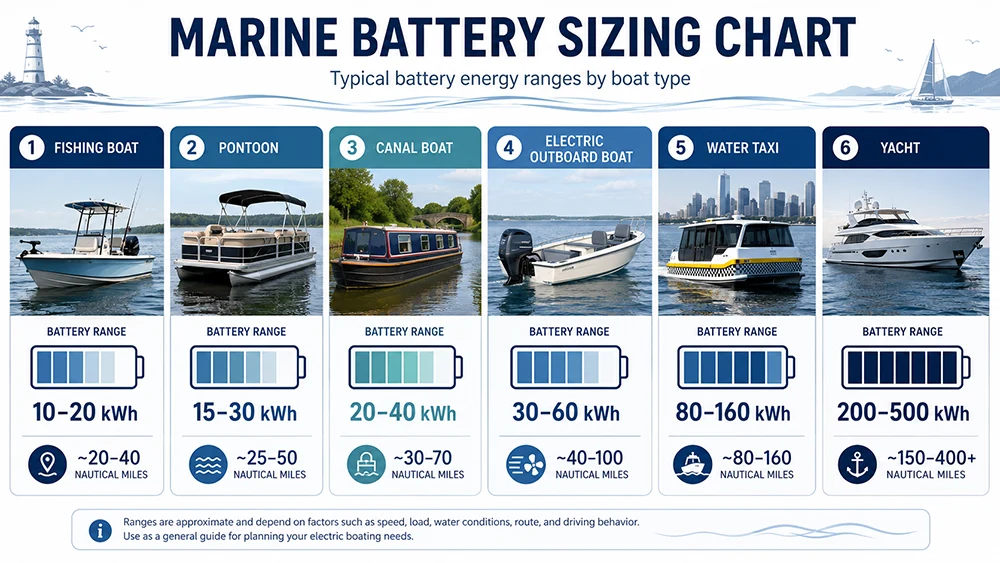
A small electric fishing boat may need only 5–10kWh. A pontoon boat may need 10–30kWh. A 20kW electric outboard boat often needs 20–40kWh. A water taxi or commercial passenger boat may need 80–200kWh or more.

The fastest first estimate is:

* Required gross battery kWh = motor power kW × target runtime hours ÷ usable DOD

If you want a 20kW motor to run for 2 hours and you plan to use 80% of the battery:

* 20kW × 2h ÷ 0.8 = 50kWh gross battery capacity

That does not mean the boat always uses 20kW. It means the battery is sized for that worst-case power level. In normal cruising, actual runtime is often longer.

1.1 Simple Formula for Electric Boat Battery Capacity ⇱

Use this simple formula:

* Battery energy kWh = nominal voltage × Ah ÷ 1000

Example:

* 96V × 200Ah ÷ 1000 = 19.2kWh

If you use 80% of that battery:

* 19.2kWh × 0.8 = 15.36kWh usable energy

That usable energy is what your boat can actually spend during normal operation.

1.2 Why kWh Matters More Than Ah Alone

Ah is only half of the story. kWh tells you the real stored energy.

A 48V 200Ah battery and a 96V 200Ah battery both say “200Ah,” but they are not the same size.

Battery System Ah Energy
48V 200Ah 200Ah 9.6kWh
96V 200Ah 200Ah 19.2kWh
400V 200Ah 200Ah 80kWh

A 96V 200Ah battery stores twice the energy of a 48V 200Ah battery.
A 400V 200Ah battery stores more than eight times the energy of a 48V 200Ah battery.

This is why serious electric boat projects should compare kWh, not only Ah.

1.3 Example: 48V, 96V ⇱, and 400V Electric Boat Battery Capacity Compared

Voltage Capacity Energy Typical Use
48V 200Ah 9.6kWh Small leisure boat, fishing boat, small pontoon
96V 200Ah 19.2kWh Electric outboard boat, work boat, small commercial boat
400V 200Ah 80kWh Electric yacht, water taxi, passenger boat, catamaran

The higher-voltage pack is not “better” in every case. It is better when the boat needs higher power, lower current, smaller cables, and more efficient power delivery.

Calculate kWh, Runtime, Speed, and Range

2. What Is Electric Boat Battery Capacity?

Electric boat ⇱ battery capacity is the amount of electrical energy stored in the boat battery system. It is usually measured in kilowatt-hours, or kWh.

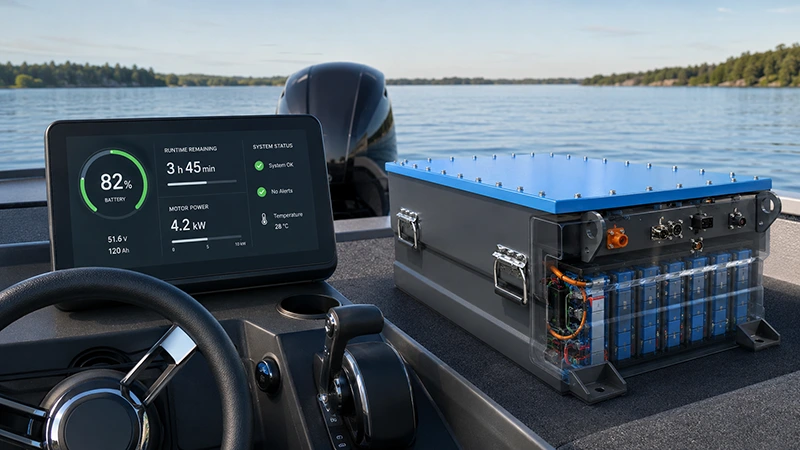
A battery with more kWh can run the boat longer, support higher power, or give more range. But the boat must also have enough BMS current, safe cable sizing, waterproof protection, and the correct voltage platform.

2.1 Battery Capacity in kWh Explained

kWh means kilowatt-hour.

1kWh means the battery can supply 1kW for about 1 hour under ideal conditions.

Examples:

Usable Energy Load Estimated Runtime
10kWh 5kW 2 hours
20kWh 10kW 2 hours
40kWh 20kW 2 hours
80kWh 40kW 2 hours

This is the cleanest way to understand electric boat runtime.

2.2 Battery Capacity in Ah Explained

Ah means amp-hour. It tells you how much current a battery can deliver over time.

A 200Ah battery can theoretically deliver:

  • 200A for 1 hour
  • 100A for 2 hours
  • 50A for 4 hours

But Ah does not tell you the energy unless you also know the voltage.

2.3 How Voltage Changes the Meaning of Ah

The same Ah value can mean very different energy.

Formula:

* kWh = voltage × Ah ÷ 1000

Battery Formula Energy
48V 100Ah 48 × 100 ÷ 1000 4.8kWh
72V 100Ah 72 × 100 ÷ 1000 7.2kWh
96V 100Ah 96 × 100 ÷ 1000 9.6kWh
400V 100Ah 400 × 100 ÷ 1000 40kWh

Ah without voltage is like saying a fuel tank is “200 units” without saying the tank size. It sounds useful, but it is incomplete.

2.4 Why Two 200Ah Batteries Can Have Very Different Energy

A 48V 200Ah pack is about 9.6kWh.
A 96V 200Ah pack is about 19.2kWh.
A 400V 200Ah pack is about 80kWh.

All three are “200Ah,” but the 400V battery stores far more energy.

This is why electric boat battery sizing should always start with kWh.

Electric Boat Battery Capacity Calculator Formula

3. Electric Boat Battery Capacity Calculator Formula

You can estimate electric boat battery capacity with four basic formulas.

These formulas are simple, but they are powerful enough for early project planning.

3.1 Formula 1: Battery Energy = Voltage × Ah ÷ 1000

* Battery kWh = nominal voltage × amp-hours ÷ 1000

Example:

* 102.4V × 400Ah ÷ 1000 = 40.96kWh

This is gross energy. Usable energy is lower after DOD reserve.

3.2 Formula 2: Runtime = Usable Battery kWh ÷ Motor Power kW

* Runtime hours = usable battery kWh ÷ average motor power kW

Example:

A 40kWh battery used at 80% DOD gives:

* 40kWh × 0.8 = 32kWh usable

If the boat cruises at 10kW:

* 32kWh ÷ 10kW = 3.2 hours

3.3 Formula 3: Range = Boat Speed × Runtime

* Range = speed × runtime

If speed is in knots, range is in nautical miles.

Example:

* 8 knots × 3.2 hours = 25.6 nautical miles

If speed is in mph, range is in miles.

3.4 Formula 4: Required Battery Capacity = Motor Power × Target Runtime ÷ Usable DOD

* Required gross kWh = average power kW × target runtime hours ÷ usable DOD

Example:

You want 4 hours of cruising at 8kW average power and 80% usable DOD:

* 8kW × 4h ÷ 0.8 = 40kWh gross battery capacity

This formula is the best starting point for most electric boat battery projects.

Step-by-Step Electric Boat Battery Sizing Guide

4. Step-by-Step Electric Boat Battery Sizing Guide

Battery sizing becomes much easier when you follow the same order every time.

Do not start by asking, “How many Ah do I need?”
Start by asking, “How many kWh do I need for my real boat use?”

Step 1: Confirm Your Motor Power

First, confirm the motor power.

You need three numbers:

Item Why It Matters
Rated motor power Main sizing reference
Peak motor power BMS and cable safety
Controller current Battery discharge current requirement

A 20kW motor may pull much higher current during acceleration. The battery must support both continuous power and short peak demand.

Step 2: Choose the Right System Voltage

Higher voltage reduces current for the same power.

Formula:

* Current A = power W ÷ voltage V

Example for a 20kW motor:

Voltage Current at 20kW
48V about 417A
96V ⇱ about 208A
400V about 50A

Lower current usually means less cable heat, smaller cables, and easier high-power system design.

Step 3: Define Your Target Runtime

Decide your real use case:

  • 1 hour full-power test?
  • 2 hours mixed cruising?
  • 4–6 hours rental boat operation?
  • All-day commercial service with opportunity charging?

Runtime is not one number. A boat can run for 1 hour at high speed or 5 hours at slow speed using the same battery.

Step 4: Estimate Your Average Cruising Power

Average cruising power is often much lower than peak motor power.

A 20kW motor may use:

Operation Mode Typical Power
Docking / slow speed 1–3kW
Easy cruising 5–8kW
Normal cruising 8–12kW
High speed 15–20kW
Full throttle 20kW+

For real battery sizing, average cruising power is more useful than peak power.

Step 5: Add Safety Margin for Wind, Waves, Load, and Battery Aging

Marine projects need reserve.

A calm lake test is not the same as a windy harbor route with passengers.

We normally recommend adding at least 15–30% margin for:

  • Wind
  • Waves
  • River current
  • Extra passengers
  • Cargo
  • Fouled hull
  • Cold weather
  • Battery aging
  • Emergency return reserve

A battery that is “just enough” on paper is often not enough on water.

Electric Boat Runtime Calculator

5. Electric Boat Runtime Calculator: How Long Will the Battery Last?

Runtime depends on usable kWh and actual power draw.

The key formula is:

* Runtime = usable battery kWh ÷ average power kW

5.1 Runtime Example for a 10kW Electric Outboard

Assume:

  • Motor: 10kW
  • Battery: 20kWh gross
  • Usable DOD: 80%
  • Usable energy: 16kWh
Power Use Runtime
10kW full power 1.6 hours
7kW fast cruise 2.3 hours
5kW easy cruise 3.2 hours
3kW slow cruise 5.3 hours

A 10kW outboard does not always consume 10kW. That is why cruising runtime can be much better than full-throttle runtime.

5.2 Runtime Example for a 20kW Electric Outboard

Assume:

  • Motor: 20kW
  • Battery: 40kWh gross
  • Usable DOD: 80%
  • Usable energy: 32kWh
Power Use Runtime
20kW full power 1.6 hours
15kW fast cruise 2.1 hours
10kW normal cruise 3.2 hours
6kW slow cruise 5.3 hours

For many leisure boats, the best range often comes from 40–60% of peak motor power.

5.3 Runtime Example for a 40kW Commercial Boat System

Assume:

  • Motor system: 40kW
  • Battery: 100kWh gross
  • Usable DOD: 80%
  • Usable energy: 80kWh
Power Use Runtime
40kW full power 2 hours
30kW heavy operation 2.7 hours
20kW route cruising 4 hours
12kW low-speed operation 6.7 hours

Commercial boats should be sized more conservatively because downtime costs money.

5.4 Why Full-Throttle Runtime Is Much Shorter Than Cruising Runtime

Full throttle drains the battery quickly because power demand rises sharply with speed.

In simple words:

Speed is fun. Speed is also expensive.

A boat that runs 4 hours at slow cruise may run only 1 hour at high speed.

This is normal for electric boats.

How Far Can an Electric Boat Go?

6. Electric Boat Range Calculator: How Far Can an Electric Boat Go?

Range is runtime multiplied by speed.

* Range = speed × runtime

If speed is in knots, range is in nautical miles.

6.1 Why Boat Speed Has a Huge Impact on Range

Boat range is highly sensitive to speed.

A boat does not move through water like a car moves on a flat road. Water resistance increases fast as speed rises.

In many displacement boat conditions, power can rise roughly with the cube of speed. That means doubling speed can require much more than double the power.

This is why the most efficient electric boat speed is often a calm, steady cruising speed.

6.2 Range Example at 5 Knots, 8 Knots, and 12 Knots

Assume:

  • Usable battery: 32kWh
  • Same boat
  • Different cruising speeds
Speed Estimated Power Runtime Range
5 knots 4kW 8 hours 40 nautical miles
8 knots 10kW 3.2 hours 25.6 nautical miles
12 knots 28kW 1.14 hours 13.7 nautical miles

This table is not a guarantee. It is a practical example showing the relationship between speed and range.

6.3 Why Slower Cruising Can Greatly Increase Range

Slower cruising can increase range because the boat uses less power per mile.

If you reduce speed from 12 knots to 8 knots, the trip takes longer, but battery consumption may drop so much that total range improves.

For rental boats, canal boats, fishing boats, and harbor work boats, efficient cruising speed is often more valuable than top speed.

6.4 How Hull Type Affects Electric Boat Range

Hull type changes energy use.

Hull Type Range Behavior
Displacement hull Best at low and moderate speed
Semi-displacement hull Moderate efficiency, depends on speed
Planing hull Needs high power to climb and stay on plane
Catamaran Can be efficient if designed for low drag
Heavy work boat Needs larger reserve because payload changes

A good battery estimate should include hull type, not only motor power.

Speed vs Battery Consumption

7. Speed vs Battery Consumption: Why Faster Boats Need Much Bigger Batteries

Fast boats need bigger batteries because water resistance rises quickly with speed ⇱.

A small increase in speed can create a large increase in battery consumption.

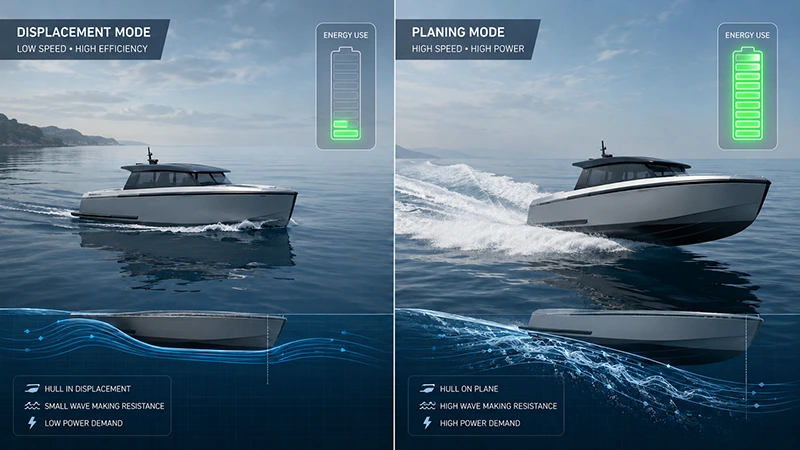
7.1 Displacement Boats vs Planing Boats

A displacement boat pushes water aside and moves through the water. It is usually efficient at low speed.

A planing boat rises up and skims on top of the water. It can go faster, but it needs much more power to get on plane and stay there.

Boat Type Best Battery Strategy
Canal boat Large kWh, low-speed efficiency
Pontoon boat Moderate kWh, steady cruising
Fishing boat Balance weight and runtime
Planing boat High discharge current and larger reserve
Water taxi Route-based commercial sizing

7.2 Why Doubling Speed Does Not Mean Doubling Power

In many boat conditions, doubling speed can require about 8 times the power.

This comes from the rough cube relationship:

* Power increase ≈ speed increase³

Example:

* 2 × speed can require about 2³ = 8 × power

Real boats vary, but the lesson is clear:

High speed needs a much bigger battery than slow cruising.

7.3 Why Commercial Boats Need More Conservative Battery Sizing

Commercial boats need reserve because they must complete routes safely and on schedule.

A commercial battery design should consider:

  • Worst-case passenger load
  • Daily operating hours
  • Charging window
  • Route distance
  • Emergency reserve
  • Battery aging
  • BMS thermal limits
  • Maintenance schedule
  • Local safety rules

For commercial boats, the right battery is not the smallest battery that works once. It is the battery that works every day.

Usable Battery Capacity: Why You Should Not Use 100% of the Battery

8. Usable Battery Capacity: Why You Should Not Use 100% of the Battery

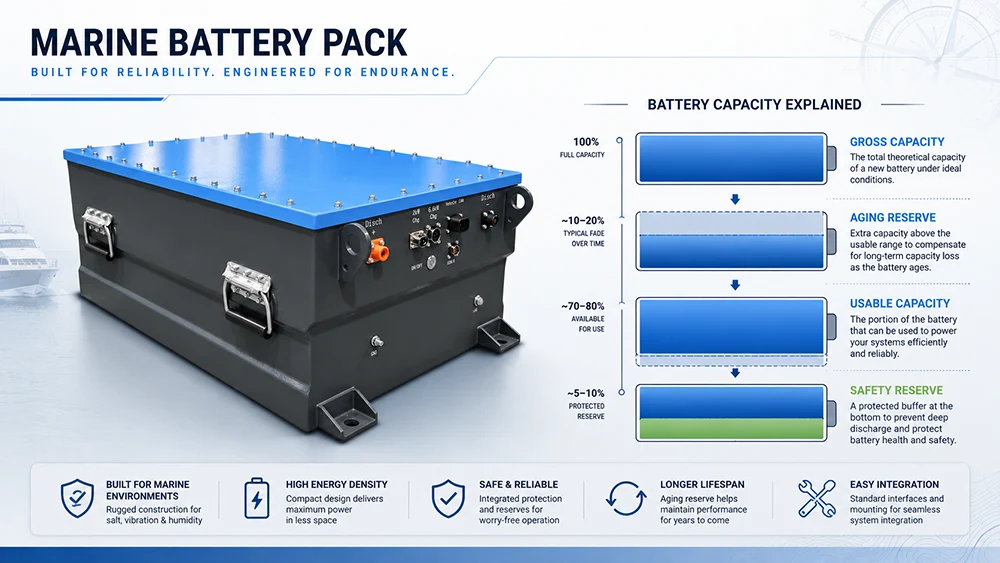
Gross battery capacity is not the same as usable battery capacity.

A 20kWh battery should not be planned as 20kWh of daily usable energy.

8.1 Depth of Discharge Explained

Depth of discharge ⇱, or DOD, means the percentage of battery energy used.

If a 20kWh battery uses 10kWh:

DOD = 50%

If it uses 16kWh:

DOD = 80%

If it uses the full 20kWh:

DOD = 100%

A higher DOD ⇱ gives more energy per trip, but it usually increases battery stress over time.

8.2 Recommended Usable Capacity for LiFePO4 Marine Batteries

For many LiFePO4 marine projects, a practical daily design range is:

Use Case Recommended Usable DOD
Leisure boat 80–90%
Rental boat 75–85%
Commercial boat 70–85%
Emergency reserve required Lower usable DOD
Long cycle-life priority Lower usable DOD

For most real marine projects, 80% usable capacity is a safe starting point.

8.3 Battery Aging and Capacity Reserve

Batteries lose capacity over time. Heat, high current, high state of charge storage, and deep cycling can speed up aging.

A good marine battery plan should include aging reserve.

If your route needs 30kWh today, do not design exactly 30kWh usable. Add margin so the boat still performs after years of service.

8.4 Why a 20kWh Battery May Only Give 16–18kWh of Practical Energy

A 20kWh LiFePO4 battery used at 80–90% DOD gives:

Gross Capacity Usable DOD Practical Usable Energy
20kWh 80% 16kWh
20kWh 85% 17kWh
20kWh 90% 18kWh

This is why a battery that looks large on paper may feel smaller in real use.

9. 48V vs 72V vs 96V vs 400V: Which Voltage Is Best for Your Boat?

The best voltage depends on motor power, current, boat size, safety requirements ⇱, and available installation space.

A simple rule is:

Small boat: 48V
Medium boat: 72V
Higher-power electric outboard: 96V or 102V
Commercial or yacht system: 300V–400V

9.1 48V Battery Systems for Small Leisure Boats

48V is common for small boats because it is simple and cost-effective.

Typical use:

  • Small fishing boats
  • Leisure boats
  • Small pontoon boats
  • Low-speed lake boats
  • 3–10kW motors

A 48V system is not ideal for high power because current becomes very high.

9.2 72V Battery Systems for Medium Electric Boats

72V is a useful middle ground.

Typical use:

  • Medium pontoon boats
  • Small passenger boats
  • 8–15kW motors
  • More runtime than small 48V systems

72V can reduce current compared with 48V while keeping the system simpler than high voltage.

9.3 96V / 102V Battery Systems for Electric Outboards and Work Boats

96V and 102V systems are common for higher-power electric outboard boats and work boats.

Typical use:

  • 10–40kW electric outboards
  • Work boats
  • RIB boats
  • Tenders
  • Small commercial boats
  • Rescue boats

A 96V system gives a good balance between power, current, cable size, and system cost.

9.4 300V–400V Battery Systems for Electric Yachts, Water Taxis, and Commercial Boats

300V–400V systems are used when the boat needs high power and large energy.

Typical use:

  • Electric yachts
  • Catamarans
  • Water taxis
  • Passenger boats
  • Commercial route boats
  • Hybrid marine systems

High-voltage systems need stronger engineering control, insulation design, safety logic, and qualified installation.

9.5 How Higher Voltage Reduces Current, Cable Size, and Heat

For the same power, higher voltage means lower current.

Example: 40kW motor system

Voltage Current
48V about 833A
96V about 417A
400V about 100A

Cable heat rises with current squared:

Heat loss ∝ I²R

So reducing current can greatly reduce heat loss and cable stress.

This is one of the main reasons higher-power boats move to higher voltage.

Battery Capacity Examples by Boat Type

10. Battery Capacity Examples by Boat Type

The following examples are starting points, not final engineering values.

Final sizing should be based on motor power, speed target, route profile, hull data, payload, battery space, and charging plan.

10.1 Small Fishing Boat Battery Capacity Example

Typical system:

  • Voltage: 48V
  • Motor: 3–10kW
  • Battery: 5–15kWh

Example:

A 48V 200Ah battery gives about 9.6kWh gross. At 80% DOD, usable energy is about 7.68kWh.

If the boat cruises at 3kW:

* 7.68kWh ÷ 3kW = 2.56 hours

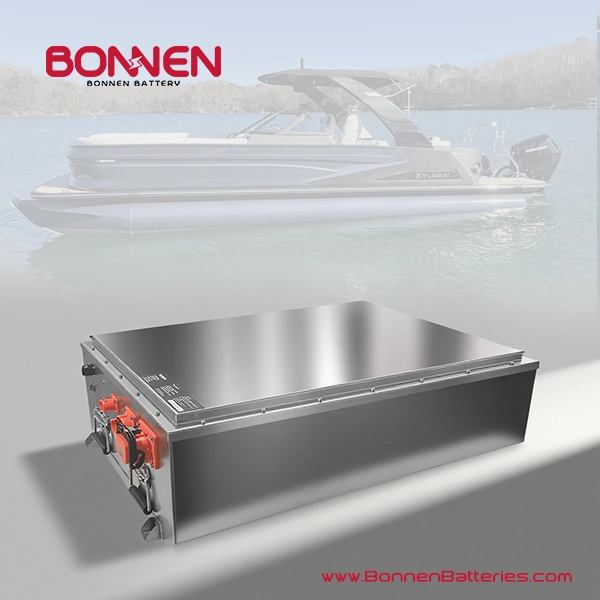
10.2 Pontoon Boat Battery Capacity Example

Typical system:

  • Voltage: 48V or 72V
  • Motor: 5–15kW
  • Battery: 10–30kWh

Pontoon boats are often used at moderate speed, so the battery can perform well if the speed target is realistic.

10.3 Canal Boat Battery Capacity Example

Typical system:

  • Voltage: 48V, 72V, or 96V
  • Motor: 5–20kW
  • Battery: 15–60kWh

Canal boats ⇱ often operate at low speed for long hours. This makes kWh more important than peak discharge power.

For a canal boat cruising at 5kW average power for 6 hours:

* 5kW × 6h ÷ 0.8 = 37.5kWh gross capacity

10.4 Electric Outboard Boat Battery Capacity Example

Typical system:

  • Voltage: 96V or 102V
  • Motor: 10–40kW
  • Battery: 15–80kWh

For a 20kW electric outboard ⇱ with 2 hours of full-power requirement:

* 20kW × 2h ÷ 0.8 = 50kWh gross capacity

If cruising power is only 10kW, the same battery can support much longer operation.

10.5 Water Taxi Battery Capacity Example

Typical system:

  • Voltage: 300V–400V
  • Motor: 40–150kW+
  • Battery: 80–300kWh+

Water taxis should be sized by route, not guesswork.

You need:

  • Route distance
  • Average speed
  • Stops per day
  • Passenger load
  • Charging window
  • Reserve requirement
  • Local safety rules

10.6 Electric Yacht or Catamaran Battery Capacity Example

Typical system:

  • Voltage: 96V, 300V, or 400V
  • Battery: 50–500kWh+
  • Motor: depends heavily on vessel size

Yachts and catamarans often need both propulsion energy and hotel loads.

Hotel loads may include:

  • Air conditioning
  • Lighting
  • Refrigerator
  • Navigation
  • Pumps
  • Kitchen loads
  • Entertainment systems

For larger boats, hotel loads can be a major part of total battery sizing.

Common Mistakes When Calculating Electric Boat Battery Capacity

11. Common Mistakes When Calculating Electric Boat Battery Capacity

Most battery sizing mistakes happen because people use the wrong starting point.

The battery should match the boat’s real operating profile, not only the motor label.

Mistake 1: Using Motor Peak Power Instead of Average Cruising Power

Peak motor power is important for BMS and cable design.

Average cruising power is important for runtime and range.

You need both.

Mistake 2: Only Comparing Ah Without Checking Voltage

A 200Ah battery can be small or large depending on voltage.

Always compare kWh.

Mistake 3: Ignoring Usable Capacity and DOD

A 40kWh battery is not always 40kWh of daily usable energy.

At 80% DOD, it gives 32kWh usable energy.

Mistake 4: Forgetting Wind, Waves, Payload, and Current

Water conditions can change energy use quickly.

A boat that runs well with two passengers on calm water may consume much more power with eight passengers and headwind.

Mistake 5: Choosing a Battery Without Checking BMS Discharge Current

The battery must support the motor controller current.

Check:

  • Continuous discharge current
  • Peak discharge current
  • Peak duration
  • BMS temperature protection
  • Connector rating
  • Cable size
  • Fuse and contactor design
  • Communication protocol

A battery with enough kWh can still fail if the BMS current is too low.

design marine projects

12. How Bonnen Battery Helps Size Custom Electric Boat Battery Packs

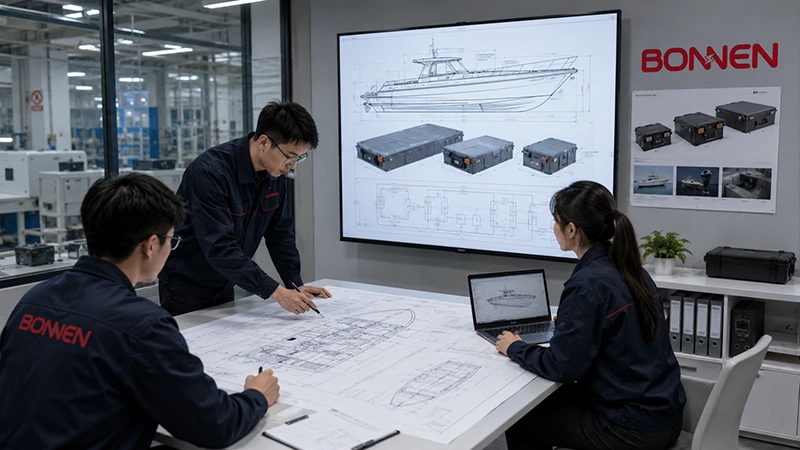
At Bonnen Battery, we do not size marine batteries by Ah alone. We start with the boat, motor, controller, route, and installation space.

Our goal is simple: the battery should fit the boat, support the motor, survive the marine environment, and give the range the project needs.

12.1 Matching Battery Capacity with Motor Power and Controller Current

We ask for:

  • Motor rated power
  • Motor peak power
  • Controller maximum current
  • System voltage
  • Target runtime
  • Boat speed
  • Boat weight
  • Installation space
  • Charger requirement
  • Communication protocol

Then we calculate the required kWh and check whether the BMS can safely support the current.

12.2 Custom Marine Battery Pack Design for Limited Boat Space

Many electric boat projects have limited battery space.

We can design custom battery packs around:

  • Long and narrow battery bays
  • Under-seat spaces
  • Engine room conversion areas
  • Pontoon compartments
  • Catamaran hull spaces
  • Waterproof deck boxes
  • Multi-pack layouts

For example, in 96V and 102V marine projects, we often design battery packs around the customer’s motor power and exact boat space instead of forcing a standard box into the vessel.

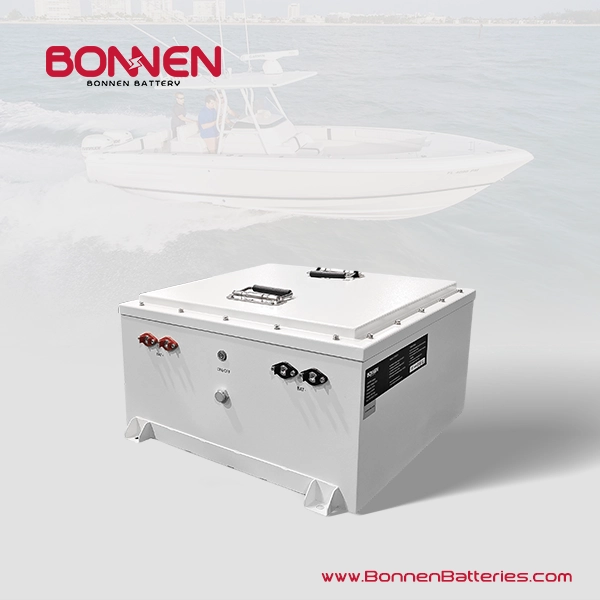
12.3 IP67 Waterproof Battery Enclosure for Marine Use

Marine batteries must handle moisture, vibration, salt air, and installation movement.

A good marine battery pack should consider:

  • Waterproof enclosure design
  • Sealing structure
  • Pressure relief
  • Cable outlet position
  • Connector protection
  • Internal fixing
  • Corrosion-resistant materials
  • Service access
  • Safe mounting points

IP67 design is important, but IP rating alone is not the full answer. A marine battery also needs good mechanical design and correct installation.

12.4 CAN, RS485, Display, Charger, and System Integration Support

A marine battery is part of a full system.

We can support:

  • CAN communication
  • RS485 communication
  • Display integration
  • Charger matching
  • Battery parallel design
  • High-voltage system design
  • Custom cable and connector support
  • BMS logic discussion
  • Installation guidance

For commercial boats, the battery, charger, motor controller, and display should work as one system.

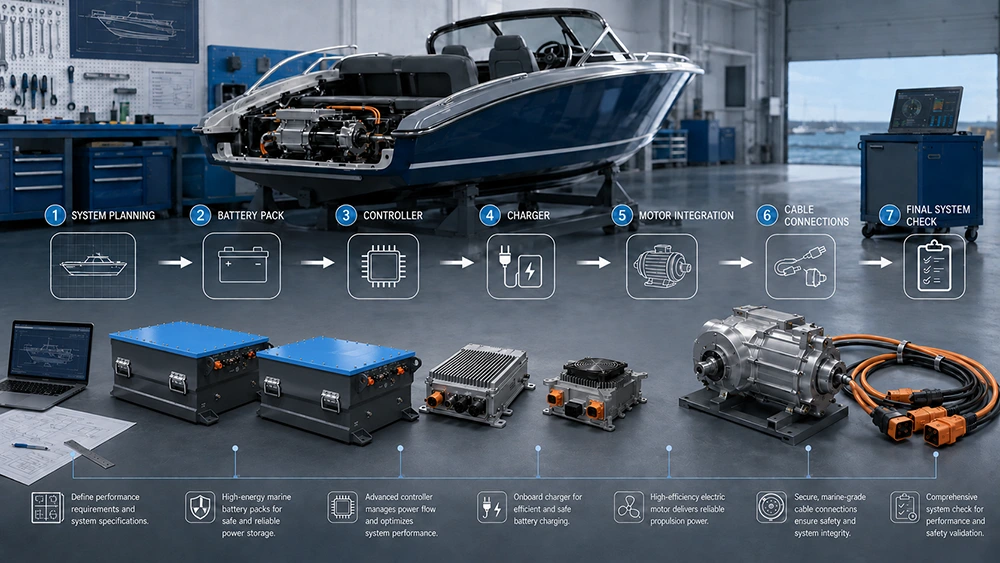
12.5 From Battery Calculation to Complete Marine Battery Solution

A good electric boat battery project has five steps:

  1. Confirm motor and controller data.
  2. Calculate required kWh and current.
  3. Check voltage platform and battery space.
  4. Design the pack structure, BMS ⇱, enclosure, and connectors.
  5. Test and support integration with the boat system.

If you are building an electric boat, upgrading from lead-acid, converting a diesel boat, or developing a commercial marine project, send us your motor power, voltage, target runtime, speed, and available battery space. We can help you calculate the battery size and design a custom marine lithium battery pack.

13. FAQ

1. How do I calculate electric boat battery size?

Use this formula: required battery kWh = average motor power kW × target runtime hours ÷ usable DOD. If your boat uses 10kW average power for 3 hours and you use 80% DOD, you need 10 × 3 ÷ 0.8 = 37.5kWh gross battery capacity.

2. How many kWh does a 10kW electric outboard need?

For one hour at full power, a 10kW electric outboard needs about 10kWh usable energy. With 80% usable DOD, the gross battery should be about 12.5kWh. For two hours, use about 25kWh gross as a starting point.

3. How long will a 48V 200Ah boat battery run?

A 48V 200Ah battery has about 9.6kWh gross energy. At 80% DOD, usable energy is about 7.68kWh. If your boat uses 3kW, runtime is about 2.56 hours.

4. How many kWh is a 96V 200Ah marine battery?

A 96V 200Ah marine battery is about 19.2kWh. At 80% DOD, practical usable energy is about 15.36kWh.

5. Is Ah enough to compare electric boat batteries?

No. Ah alone is not enough because voltage changes total energy. Always compare batteries by kWh. A 96V 100Ah battery has twice the energy of a 48V 100Ah battery.

6. What battery size do I need for a 20kW electric outboard?

For one hour at full power, a 20kW outboard needs about 20kWh usable energy. With 80% DOD, the gross battery should be about 25kWh. For two hours at full power, start around 50kWh gross.

7. How much range can I get from a 20kWh electric boat battery?

It depends on speed and power use. If usable energy is 16kWh and the boat cruises at 4kW, runtime is 4 hours. At 5 knots, range is about 20 nautical miles. At higher speed, range may drop sharply.

8. Why does my electric boat range drop so fast at high speed?

Range drops because water resistance rises quickly with speed. In many boat conditions, doubling speed can require much more than double the power. High speed is the biggest enemy of electric boat range.

9. What DOD should I use for LiFePO4 marine batteries?

For many LiFePO4 marine projects, 80–90% usable DOD is practical. For commercial boats or long cycle-life targets, 70–85% is often safer.

10. Should I choose 48V or 96V for my electric boat?

Choose 48V for small, low-power boats. Choose 96V or 102V when the motor power is higher, current is too large, or cable size becomes difficult. For 10–40kW electric outboards, 96V is often a better platform.

11. When does a boat need a 400V battery system?

A boat may need 300V–400V when the system has high motor power, large battery capacity, or commercial operation. Water taxis, electric yachts, catamarans, and larger passenger boats often benefit from high-voltage battery systems.

12. How much safety margin should I add to an electric boat battery?

A good starting point is 15–30% extra capacity. Add more if the boat carries passengers, works in wind or current, has a strict route schedule, or needs emergency reserve.

13. How do I know if the BMS discharge current is enough?

Check the motor controller’s maximum current and compare it with the battery BMS continuous and peak discharge ratings. The BMS, connectors, cables, fuses, and contactors must all support the current safely.

14. Can solar panels extend electric boat range?

Yes, but solar usually helps more with hotel loads or slow charging than high-speed propulsion. A 1kW solar array can add about 1kWh per strong sun hour before system losses. That is useful, but it will not replace a large propulsion battery for high-power boats.

15. How do I size the charger for an electric boat battery?

Charger size depends on battery capacity and desired charging time. Formula: charger kW = battery kWh ÷ charging hours. A 40kWh pack charged in 5 hours needs about an 8kW charger before considering losses and charging limits.

16. Can I replace lead-acid boat batteries with lithium?

Yes, but it should be checked carefully. You need to confirm voltage, motor/controller current, charger compatibility, battery space, cable size, protection devices, and installation safety. Lithium is not just a drop-in choice for every boat.

17. What battery capacity does a canal boat need?

Many canal boat projects use 15–60kWh depending on motor power and cruising hours. A canal boat using 5kW average power for 6 hours needs about 37.5kWh gross at 80% DOD.

18. What battery capacity does a water taxi need?

A water taxi may need 80–300kWh or more. The correct size depends on route distance, passenger load, speed, daily operating hours, and charging windows.

19. What information should I send to Bonnen Battery for sizing?

Send motor power, system voltage, controller current, target runtime, target speed, boat type, boat weight, available battery space, charger requirement, and communication protocol. Photos or drawings of the battery compartment are also helpful.

20. Can Bonnen Battery make a custom battery shape for my boat?

Yes. We can design custom marine lithium battery packs based on available space, voltage, capacity, current, waterproof enclosure, connector position, BMS, and communication needs.

21. What battery capacity does an electric yacht or catamaran need?

Small electric yacht projects may start around 50–100kWh. Larger catamarans, passenger yachts, or long-range systems may need several hundred kWh. Hotel loads must also be included in the calculation.

22. How accurate is an electric boat battery calculator?

A calculator gives a good first estimate, but real range depends on hull design, propeller, speed, wind, waves, payload, water current, battery temperature, and battery aging. For final design, real route data or sea trial data is best.

Contact Bonnen Batterynow and let us help you power your adventures with the best lithium battery technologies.

© [Bonnen Battery] and [www.bonnenbatteries.com]. Unauthorized use and/or duplication of this material without express and written permission from this site’s author and/or owner is strictly prohibited. Excerpts and links may be used, provided that full and clear credit is given to [Bonnen Battery] and [www.bonnenbatteries.com] with appropriate and specific direction to the original content.
Electric Boat Lithium Batteries from Bonnen Battery​

boat lithium battery
Boat Lithium Battery
boat lithium battery
Electric Vehicle lithium battery
Commercial battery storage

Get In Touch Bonnen Battery

Xiangfeng Science Industrial Park, Changsha City, Hunan Province, China

Web: www.bonnenbatteries.com