
Electric farm tractor operating in an agricultural field

AGRICULTURAL ELECTRIFICATION / OEM BATTERY SOLUTIONS

Custom Electric Tractor Battery Systems for Agricultural OEMs

LiFePO4 and NMC battery packs engineered for electric farm tractors, from compact utility machines to high-voltage agricultural platforms. Designed around your power requirements, operating hours, installation space and vehicle integration needs.

Explore Battery Platforms ↓
  • Application-Based Battery Sizing
  • Custom Enclosure Design
  • BMS & Vehicle Integration

TRACTOR DUTY CYCLES

Engineered for Real Agricultural Operating Conditions

Tractor battery design starts with the work the machine needs to do. Traction, hydraulic and PTO-related demand, auxiliary loads and changing duty cycles all influence battery power, usable energy and integration requirements.

Continuous & Peak Power

Evaluate sustained demand, short load peaks and current limits across the intended duty cycle.

Duty Cycle & Runtime

Size usable energy around real tasks, operating hours and charging opportunities.

Mechanical & Environmental Design

Review enclosure space, mounting, vibration exposure, dust, moisture and service access.

BMS & Vehicle Communication

Define battery monitoring, control interfaces and CAN communication requirements for the vehicle.

REAL PRODUCT REFERENCES

Electric Tractor Battery Platforms

Explore Bonnen battery references for different tractor architectures, or discuss a custom system built around your vehicle requirements.
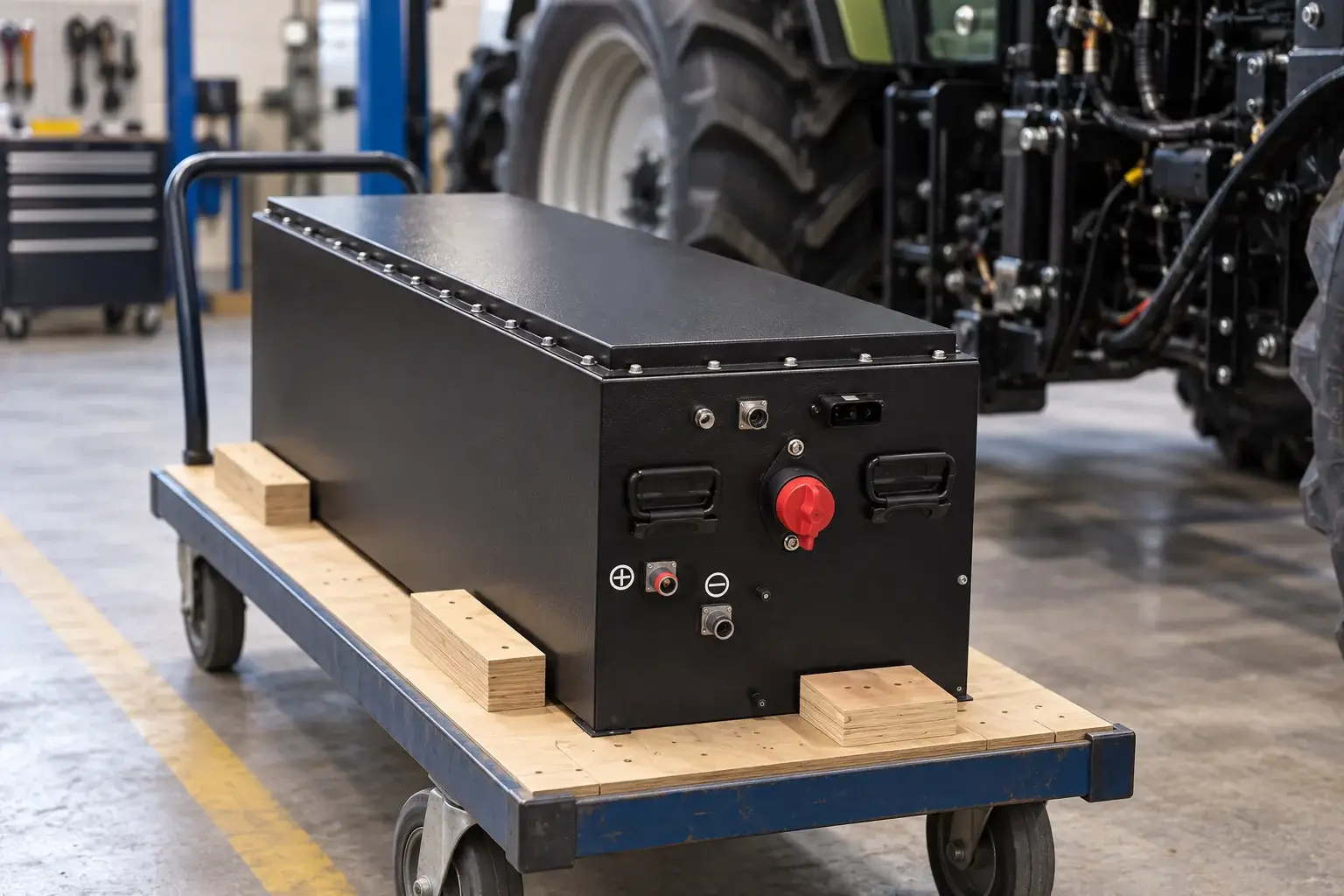
96V LiFePO4 tractor battery reference in a clean engineering integration setting

REFERENCE PLATFORM 01

96V 200Ah LiFePO4 Tractor Battery

96V Platform200Ah19.2kWhLiFePO4IP67

A battery reference for compact electric tractor development. Review its electrical specifications, enclosure dimensions and interface requirements against your vehicle design.

All Bonnen tractor battery systems are engineered with an IP67-rated enclosure.

View 96V Battery Details ↗
600V-Class NMC tractor battery reference in an industrial integration bay

REFERENCE PLATFORM 02

600V-Class 100kWh NMC Tractor Battery

600V-Class100kWh ClassNMC

A high-voltage battery reference for agricultural vehicle development. Final voltage range, power capability, packaging and control interfaces are specified around the complete vehicle architecture.

Platform-level reference only. Final electrical and mechanical specifications require project confirmation.

View High-Voltage Battery Details ↗

Reference configurations. Final specifications depend on the project.

AGRICULTURAL APPLICATIONS

Battery Solutions for Different Agricultural Machinery

Different machines place different demands on traction power, hydraulics, packaging, charging access and control integration.

Compact electric utility tractor working between crop rows

Compact & Utility Tractors

Balance daily task energy, low-speed traction, implement loads and limited installation space.

High-power electric field tractor operating with agricultural equipment

High-Power Field Tractors

Evaluate sustained traction, hydraulic demand, thermal conditions and practical charging windows together.

Autonomous agricultural vehicle navigating a cultivated field

Autonomous Agricultural Vehicles

Coordinate battery monitoring, vehicle controls, charging strategy and unattended duty cycles.

Special-purpose electric agricultural machine working in an orchard

Special-Purpose Agricultural Machinery

Adapt enclosure geometry, mounting and interfaces around orchard, greenhouse or task-specific equipment.

Illustrative electric tractor battery system architecture Solid orange lines show power from the battery pack through main protection and distribution to traction, hydraulic or PTO, and auxiliary loads. Dashed blue CAN lines connect the BMS and vehicle control unit. Battery Pack Cells · enclosure contactors · sensing Main Protection / Distribution Isolation · switching fusing · power routing Traction Drive Inverter · motor · axle Hydraulic / PTO Loads Depends on vehicle architecture Auxiliary Loads Controls · pumps · HVAC BMS Monitoring · protection CAN Status · limits · faults VCU Vehicle states · commands Power path Communication path Illustrative architecture — final interfaces depend on the vehicle.

SYSTEM INTEGRATION

Connect the Battery to the Whole Vehicle Architecture

A tractor battery is one part of a coordinated electrical and mechanical system. The architecture must be reviewed against traction, implement loads, auxiliary circuits, charging and vehicle controls.

Electrical Architecture

Confirm voltage limits, continuous and peak loads, protection, distribution and charging interfaces.

Mechanical Packaging

Define enclosure envelope, mounting points, mass distribution, service access and connector orientation.

Thermal & Environmental Requirements

Set thermal strategy and environmental targets around the expected duty cycle and operating conditions.

Controls & Communication

Define BMS monitoring, vehicle states, CAN messages, fault handling and charger coordination for the specific platform.

APPLICATION-BASED SIZING

Estimate Energy from Work, Not a Nameplate Alone

Runtime depends on the combined duty cycle of traction, hydraulics, PTO-related equipment and auxiliaries—not only motor peak power.

Required nominal energy ≈ average system load × target hours ÷ usable-energy assumption

ENGINEERING & MANUFACTURING

Move from Vehicle Requirements to a Buildable Battery System

Bonnen supports OEM teams by turning vehicle inputs into a battery architecture that can be reviewed, prototyped and prepared for production.

Custom Lithium Battery Engineering ↗
Industrial battery assembly area with enclosed traction battery packs
Battery engineer reviewing vehicle integration interfaces beside a traction battery pack
01

Requirements Definition

Align application voltage, load profile, runtime, packaging, environment and charging inputs.

02

Mechanical & Electrical Design

Develop the enclosure, mounting, protection, connector and service concept around the machine.

03

BMS & Interface Definition

Coordinate monitoring, control, CAN and charger behavior for the intended vehicle architecture.

04

Prototype & Integration Support

Use samples and vehicle feedback to resolve installation, controls and duty-cycle questions.

05

Production & Quality Process

Prepare approved product documentation and process controls for the agreed project configuration.

OEM DEVELOPMENT PROCESS

A Practical Path from Requirements to Production Readiness

  1. 01

    Requirements

    Collect vehicle voltage, loads, duty cycle, space, environment, interfaces and program needs.

  2. 02

    Architecture

    Review chemistry, energy, power, enclosure, protection, thermal and communication concepts.

  3. 03

    Prototype

    Build the agreed sample configuration and prepare integration documentation.

  4. 04

    Vehicle Integration

    Validate installation, controls, charging and the intended operating profile with the OEM.

  5. 05

    Pilot / Production Readiness

    Close project findings and prepare the approved configuration for the next program stage.

FAQs About Custom Electric Tractor Battery Systems

Bonnen Battery develops customized low-voltage and high-voltage lithium battery systems for electric agricultural machinery. Our existing references include 96V LiFePO4 battery packs and 600V-class NMC battery systems. The appropriate voltage depends on the motor controller, power requirements, charging architecture and overall vehicle design.

LiFePO4 batteries are often preferred for electric tractors requiring long cycle life, thermal stability and cost-effective operation. NMC batteries offer higher energy density, making them suitable for applications where battery weight and installation space are critical. Bonnen evaluates both options according to each OEM project’s requirements.

Battery capacity should be calculated using the tractor’s actual energy consumption, desired operating hours and usable battery capacity. Traction motors, hydraulic systems, PTO equipment and auxiliary loads must all be considered. Bonnen can assist OEM customers with application-based battery sizing.

Operating time depends on battery energy, tractor workload, terrain and operating conditions. For example, a 19.2kWh battery with 80% usable energy can theoretically supply a 5kW average battery load for approximately 3 hours. Actual operating time must be validated under real agricultural working conditions.

Yes. Custom lithium battery systems can be designed to support the continuous discharge current and short-duration power peaks required by electric tractor motors. The BMS, battery cells, electrical connections and thermal design must be selected according to the motor controller’s actual power demand.

Yes, a properly designed electric tractor battery system can supply multiple electrical loads. However, traction, electric hydraulic pumps, electrically driven PTO systems and auxiliary equipment may have different operating characteristics. Total continuous demand, simultaneous load peaks and power distribution must be evaluated during system design.

Yes. Bonnen develops custom battery packs according to available installation space, weight limitations, mounting requirements and environmental conditions. Enclosure geometry, electrical interfaces, connector positioning and service access can be evaluated during the mechanical design stage.

Yes. A battery system may be divided into multiple coordinated modules when installation space, weight distribution or maintenance access makes a single enclosure impractical. The electrical architecture, BMS coordination, protection and interconnection arrangements must be designed and validated for the complete system.

Yes. Bonnen can evaluate CAN communication requirements for the battery BMS and the tractor’s vehicle controller. Supported signals and communication protocols depend on the selected BMS and agreed integration design. Customers should provide their controller’s CAN protocol documentation for engineering review.

Bonnen supports project-specific battery integration with vehicle control units, motor controllers, charging systems and electrical distribution equipment. Integration typically includes voltage compatibility, CAN messaging, contactor control, fault handling and system start-up and shutdown sequences.

Regenerative braking can be supported when the battery, BMS, motor controller and overall vehicle architecture are designed for it. Charging current limits, battery temperature, state of charge and regenerative energy levels must be considered to ensure safe operation.

Lithium battery conversion may be possible, but it requires more than matching nominal voltage. Engineers must evaluate the existing motor controller, charger, installation space, power demand, protection devices and electrical interfaces before confirming compatibility.

Bonnen offers tractor battery designs with IP67-rated enclosures. Agricultural applications also require consideration of mud, dust, moisture, vibration, mechanical mounting and connector sealing. The environmental protection requirements and validation tests should be confirmed for each battery configuration.

Operating temperature limits depend on the battery chemistry, cell selection and thermal management design. Low temperatures can reduce available discharge performance and restrict charging, while high temperatures may require additional thermal protection. Bonnen evaluates the temperature requirements of each agricultural application.

Charging time depends on battery capacity, charging power, initial state of charge, temperature and BMS charging limits. For example, charging a 100kWh battery from 20% to 80% requires approximately 60kWh of energy before accounting for losses. The required charging time must be calculated using the actual charger and battery specifications.

An existing charger may be compatible if its voltage range, charging profile, current limits and communication requirements match the lithium battery system. Bonnen can review charger specifications and recommend a suitable charging solution when necessary.

Bonnen battery systems incorporate a BMS designed to monitor battery conditions and provide appropriate protection against overvoltage, undervoltage, overcurrent and abnormal temperatures. Depending on the application, additional protection, insulation monitoring and contactor control may be required. Product-specific test reports and certification documents should be confirmed during project evaluation.

To evaluate a custom solution, Bonnen recommends providing the system voltage, continuous and peak power, target operating time, battery installation dimensions, expected temperature range, charging requirements and communication interfaces. Project quantity and development stage are also helpful for preparing an engineering proposal.

Yes. Bonnen supports prototype development for OEM customers to evaluate mechanical fit, electrical performance and vehicle integration before progressing to pilot or volume production. The prototype configuration, required testing, documentation and subsequent production quantities are agreed upon for each project.

Pricing depends on battery chemistry, energy capacity, power requirements, enclosure design, BMS features and order quantity. Production lead time depends on engineering complexity, component availability, testing requirements and order volume. Bonnen provides project-specific quotations and delivery schedules after reviewing the technical requirements.

START YOUR TRACTOR BATTERY PROJECT

Share the Inputs That Define Your Battery Architecture

Send the vehicle voltage range, continuous and peak power, target operating hours, available space, communication requirements and charging plan. Bonnen can use these inputs to evaluate a suitable project direction.