Last Updated on 31/08/2026 by Bonnen Battery
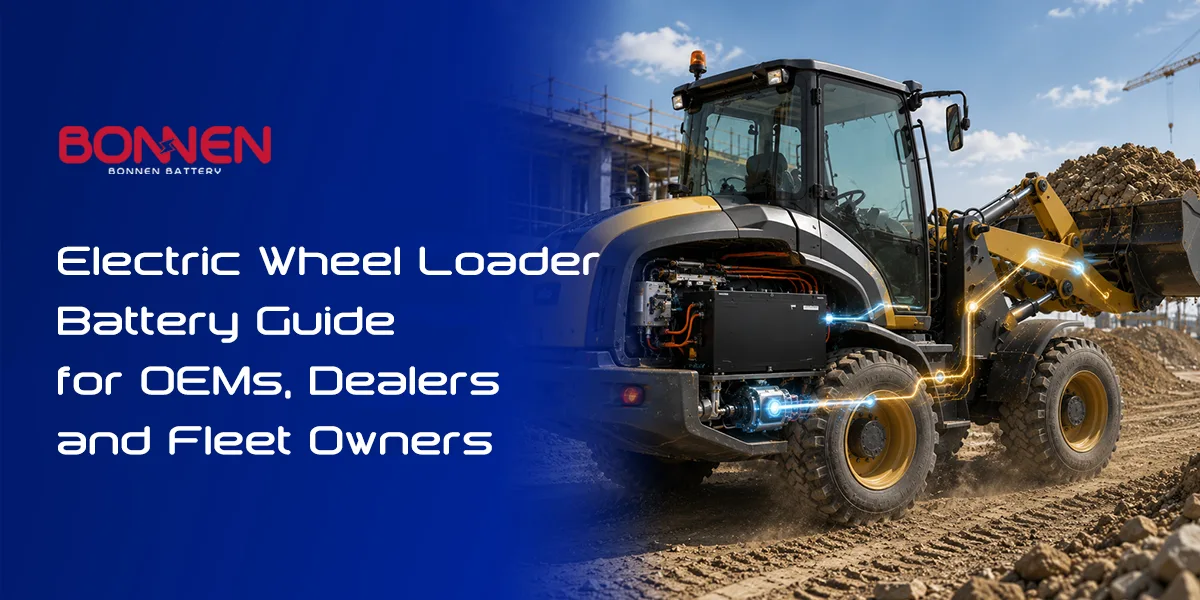
Electric Wheel Loader Battery Guide for OEMs, Dealers and Fleet Owners
An electric wheel loader battery must be selected as part of the complete machine, not as an independent box of stored energy. The correct battery must match the loader’s voltage, operating power, hydraulic demand, required runtime, installation space, charger, CAN communication and working environment.
A battery that matches only the nominal voltage may still be unsuitable. It may not provide enough current for lifting and climbing, fit the original battery compartment, communicate with the machine controller or charge safely in cold weather.
For many modern loader projects, LiFePO4 technology offers a practical balance of safety, cycle life, stable power and maintenance cost. However, there is no universal electric wheel loader battery for every model. Each OEM project or wheel loader battery replacement must be evaluated according to the actual machine.
This guide explains how OEMs, dealers and fleet owners can size, select, integrate and evaluate a lithium battery for electric loader applications.
1. What Is an Electric Wheel Loader Battery?
An electric wheel loader battery is the main rechargeable energy system that powers the loader’s traction motor, hydraulic system, steering, control units and auxiliary equipment.
Unlike a starter battery, it must support both long operating periods and short high-power events. These events may include acceleration, climbing, lifting a full bucket and operating the traction and hydraulic systems at the same time.

1.1 How an Electric Wheel Loader Battery Powers the Machine
The battery stores electrical energy in kilowatt-hours, or kWh. During operation, DC power flows from the battery to the traction motor controller and the hydraulic motor controller.
The traction controller regulates speed and torque. The hydraulic controller powers the electric pump that creates pressure for lifting, tilting and steering.
The battery may also supply a DC-DC converter, which reduces the main battery voltage to 12V or 24V for lights, displays, control units, fans and other auxiliary equipment.
The machine’s power demand changes every second. Traveling without a load may require moderate power, while pushing material or lifting on a slope may create a much higher demand. For this reason, the battery must provide enough stored energy for runtime and enough current for high-load operations.
1.2 Main Components of an Electric Loader Battery System
A complete electric loader battery ⇱ includes much more than battery cells.
| Component | Main purpose |
| Battery cells and modules | Store and deliver electrical energy |
| Battery management system | Monitors voltage, current, temperature and battery status |
| Main contactors | Connect and disconnect high-current output |
| Fuse and service disconnect | Provide electrical protection and safer maintenance |
| Current and temperature sensors | Measure operating conditions |
| CAN communication interface ⇱ | Exchanges information with the loader and charger |
| Thermal management system | Controls battery temperature |
| Enclosure | Protects the battery from impact, dust and water |
| High-current connectors | Connect the battery to the machine |
| External display | Shows SOC, warnings and battery data |
–
The BMS is the main monitoring and protection device. It can reduce charging or discharging power when the battery becomes too hot, too cold or electrically unbalanced.
However, a BMS cannot correct a battery that is too small, poorly cooled or mechanically unsuitable for the loader.
1.3 How Loader Batteries Differ from Automotive EV Batteries
Electric loaders usually work under heavier repeated loads than road vehicles.
A road vehicle often travels at a relatively stable speed. A loader may reverse every few seconds, accelerate with a heavy bucket, push into material and operate the hydraulic pump at the same time.
The working environment ⇱ is also different. A loader battery may be exposed to dust, mud, water, vibration, shock and high-pressure cleaning.
As a result, an electric construction equipment battery often requires a stronger enclosure, more protection around connectors, custom mounting points and machine-specific CAN communication.
ISO 14990 ⇱ provides electrical safety requirements for electrically driven earth-moving machinery. This supports an important principle: the battery must be evaluated as part of the whole machine, not only as an individual component.
2. Why Electric Wheel Loaders Use Lithium Batteries
Lithium batteries are widely used because they can provide high usable energy, stable voltage, high charging efficiency and low routine maintenance.
Compared with traditional lead-acid systems, a correctly designed lithium battery for electric loader applications can provide more usable capacity within the same space and maintain more stable performance during discharge.

2.1 Longer Runtime and More Stable Power Output
Lithium batteries maintain a relatively stable voltage across much of their usable state-of-charge range.
This helps the traction motor and hydraulic system provide more consistent performance during the working shift. Lead-acid batteries normally experience a greater voltage drop as they discharge, especially under high current.
Battery energy is calculated with the following formula:
* Battery energy in kWh = nominal voltage × capacity in Ah ÷ 1,000
An 80V 560Ah battery stores:
* 80 × 560 ÷ 1,000 = 44.8kWh
The full nominal energy is not normally used. The BMS usually reserves part of the battery capacity to protect the cells and increase service life.
2.2 Faster Charging and Opportunity Charging
Opportunity charging means adding energy during short breaks instead of waiting until the battery is almost empty.
For example, a loader can charge during lunch, operator changes, cleaning or material delivery delays. This strategy may reduce the size of battery required for a full shift.
A 20kW charger running for 30 minutes can theoretically provide 10kWh of energy. The actual energy stored will be slightly lower because the charger, cables and battery create some losses.
Opportunity charging works best when the daily schedule is predictable. The charger, battery cells, BMS and thermal system ⇱ must all support the planned charging rate.
2.3 Longer Cycle Life and Lower Maintenance
Battery life depends on how the battery is used.
High temperature, deep discharge, very high current and long periods at full charge can accelerate battery aging. Moderate temperatures and controlled charging normally support a longer service life.
NREL battery lifetime research identifies temperature, current, state-of-charge history and discharge depth as major factors that influence lithium battery degradation.
Lithium batteries also require less routine work than flooded lead-acid batteries. Operators do not need to add water, clean acid or perform regular equalization charging.
The battery should still be inspected for loose connectors, damaged cables, corrosion, cooling problems and recorded fault codes.
2.4 Lower Total Cost of Ownership
The cheapest battery is not always the lowest-cost battery.
A complete total cost of ownership calculation should include the battery, charger, installation, grid upgrades, maintenance, downtime, energy use and expected battery life.
| Cost area | Important question |
| Battery purchase | What is included in the battery package? |
| Charging system | Is a new charger or electrical upgrade required? |
| Installation | Are mounting or cable changes needed? |
| Operation | How many kWh are used per working hour? |
| Maintenance | What parts require inspection or replacement? |
| Downtime | How much production is lost during faults or charging? |
| Service life | How many years or operating hours are expected? |
–
A battery with correct sizing and reliable integration usually provides a lower operating cost than a cheaper battery that causes repeated machine faults.
3. How to Size an Electric Wheel Loader Battery
Battery sizing ⇱ should begin with the loader’s real working cycle.
The most accurate method is to record machine voltage, current and power during normal and demanding operations. When this data is not available, engineers can estimate demand from the traction motor, hydraulic system, operating hours and work conditions.

3.1 Determine Average and Peak Power Demand
Average power determines how much energy the machine uses during a working period.
Peak power determines whether the battery can support demanding operations without excessive voltage drop, overheating or BMS shutdown.
For example, a loader may use an average of 18kW during normal work but repeatedly reach 40kW when climbing or lifting. A very short maximum demand may be even higher.
A battery can have enough kWh for the required runtime but still be unsuitable if it cannot deliver the required peak current.
Therefore, energy capacity and current capability must be checked separately.
3.2 Define the Required Operating Time
A full shift does not always mean continuous battery use.
An eight-hour shift may include several hours of active loading, travel, idle time, operator breaks and charging periods. Fleet owners should separate total shift time from active energy-consuming time.
For example, a loader may remain on site for eight hours but perform active work for only five hours. If a charger is available during lunch, the required onboard battery capacity may be reduced further.
3.3 Calculate the Minimum Battery Energy
The basic energy calculation is:
* Required energy = average power × operating time
If the loader uses an average of 20kW for four active hours:
* 20kW × 4 hours = 80kWh
The battery should be larger than 80kWh because not all nominal capacity is usable. The design must also allow for efficiency losses, cold weather, battery aging and unexpected workload.
3.4 Add a Real-World Safety Margin
A practical calculation is:
* Nominal battery energy = required energy ÷ usable SOC ÷ system efficiency × operating margin
Assume that the machine needs 80kWh, the usable SOC range is 90%, system efficiency is 92% and the operating margin is 10%.
* 80 ÷ 0.90 ÷ 0.92 × 1.10 = approximately 106kWh
The correct margin depends on the application.
A loader working on a predictable indoor route may need a smaller reserve. A loader working outdoors in cold weather, on steep grades or with changing attachments may require a larger reserve.
3.5 Example Battery Runtime Calculation
An 80V 560Ah battery stores 44.8kWh of nominal energy.
If 90% is available for normal operation, usable energy is approximately 40.3kWh.
| Average power demand | Estimated runtime |
| 10kW | About 4.0 hours |
| 16kW | About 2.5 hours |
| 20kW | About 2.0 hours |
| 25kW | About 1.6 hours |
–
These values are planning estimates. Actual runtime depends on terrain, attachment use, hydraulic demand, ambient temperature, battery age and operator behavior.
4. Choosing the Right Battery Voltage and Power Rating
Battery voltage, current and energy must be selected together.
Voltage affects the motor controller, charger, cable size, connectors, insulation and electrical safety system.

4.1 Common Battery Voltage Platforms
Compact electric loaders may use 48V ⇱, 72V, 80V or 96V ⇱ systems. Larger machines may use battery platforms of several hundred volts ⇱.
There is no single standard voltage for all loaders.
The correct voltage is mainly determined by the motor controller, hydraulic drive, required power, charger and machine electrical architecture.
A wheel loader battery replacement should normally remain within the machine’s approved voltage range unless the complete powertrain is being redesigned.
4.2 How Voltage Affects Current and Efficiency
Electrical power is calculated with:
* Power = voltage × current
A 40kW system requires approximately 500A at 80V, but only 100A at 400V.
For the same power, higher voltage reduces current. Lower current can reduce cable size and resistive heat losses.
However, higher voltage also requires stronger insulation, safer service procedures and more advanced electrical protection.
The best system voltage is not simply the highest available voltage. It is the voltage that matches the machine’s complete design.
4.3 Matching the Battery to Traction and Hydraulic Loads
The battery must support all machine loads at the same time.
In addition to the traction motor, the battery may supply the hydraulic pump, steering, cooling fans, cabin heater, air-conditioning system, lights and electronic controls.
During real work, the operator may drive while raising a loaded bucket. The battery must support the combined traction and hydraulic demand without excessive voltage drop.
4.4 Checking the Full Operating Voltage Range
Nominal voltage is only a reference value.
The engineering team must also confirm the maximum charging voltage, minimum discharge voltage, motor-controller limits, charger range and DC-DC converter input range.
Two batteries with the same nominal voltage may still use different cell configurations and have different maximum and minimum voltages.
Their full operating ranges must be compatible with the machine.
4.5 Continuous, Peak and Regenerative Current
Continuous current is the current that the battery can provide for an extended period under defined temperature conditions.
Peak current is a higher value allowed for a short time. A peak specification should always include its duration.
For example, 500A for three seconds is different from 500A for 30 seconds.
The battery must also manage regenerative charging. When the machine slows down or lowers a load, energy may return to the battery. The BMS must control this current when the battery is full, cold or already at its charging limit.
5. Thermal Management for Electric Construction Equipment Batteries
Thermal management keeps the cells within a safe and efficient temperature range.
It also reduces temperature differences between cells, which helps maintain balanced performance and service life.

5.1 How Temperature Affects Battery Performance
Low temperature increases battery resistance and reduces available charging and discharging power.
High temperature accelerates aging and can increase safety risk.
Uneven temperature can also cause some cells to age faster than others. The hottest cells may degrade more quickly, while the coldest cells may limit charging current.
The correct temperature limits must be based on the selected cell and validated battery design.
5.2 Passive, Air and Liquid Cooling
Passive cooling uses heat spreaders, thermal pads, enclosure surfaces and natural airflow. It has few moving parts and may be suitable for moderate duty cycles.
Forced-air cooling ⇱ uses fans to move heat away from the battery. It is relatively simple, but dust and blocked airflow can reduce its effectiveness on construction sites.
Liquid cooling ⇱ is more effective for high continuous power, repeated fast charging or tightly packed batteries. It can provide more even cell temperatures but adds pumps, hoses, coolant and additional service requirements.
The thermal system should be selected from calculations and test results rather than from a general preference.
5.3 Heating for Cold Climates
Cold-climate batteries may require heating before charging or high-power operation.
Heating can be provided by films, plates or a heated liquid circuit. Insulation may also reduce heat loss.
The BMS should control the heater and prevent charging when the cells are below the approved charging temperature.
Heating consumes energy, so cold-weather runtime calculations should also include battery heating, cabin heating and defrosting loads.
5.4 Temperature Monitoring and BMS Protection
Temperature sensors may be placed on cells, busbars, contactors, connectors and cooling circuits.
When temperature approaches a limit, the BMS may first reduce available power. If the condition continues, it may stop charging or open the main contactors.
Gradual power reduction is often preferable to sudden shutdown because the operator has more time to move the loader to a safe position.
6. Mechanical Integration and Battery Enclosure Design
A battery must fit the loader, remain secure under shock and vibration, and allow safe installation and servicing.
Mechanical design is just as important as voltage and capacity.

6.1 Battery Compartment and Installation Space
A battery compartment should be measured in three dimensions.
The survey should include the internal space, installation opening, structural ribs, hoses, cable routes, cooling space and service clearance.
The battery may fit inside the compartment but still be impossible to install if the opening is too small.
A CAD model or 3D scan is usually more reliable than basic length, width and height measurements.
6.2 Battery Weight and Machine Balance
Battery weight affects axle load, traction, steering and stability.
In many wheel loaders, the rear battery also contributes to the machine’s counterweight. Replacing a heavy battery with a much lighter one can change the center of gravity and reduce stability with a loaded bucket.
A heavier battery may create the opposite problem by exceeding axle or structural limits.
For this reason, the battery supplier should provide battery weight ⇱ and center-of-gravity information, while the machine OEM or integrator should confirm overall stability.
6.3 Mounting, Vibration and Service Access
The battery must remain fixed during driving, lifting, transport and repeated shock ⇱.
Mounting loads should transfer into reinforced structural parts rather than thin enclosure panels.
The design should also provide reasonable access to the fuse, service disconnect, connectors and diagnostic interface.
A battery that requires major machine disassembly for routine service will increase downtime and maintenance cost.
6.4 Lifting Points and Forklift Pockets
Large loader batteries may weigh hundreds of kilograms.
The enclosure should include a defined and safe handling method. This may use reinforced lifting eyes, forklift pockets or a dedicated lifting frame.
Forklift pockets must be open, structurally reinforced and positioned according to the battery’s center of gravity.
Handling instructions should state the battery weight, approved lifting points and required lifting equipment.
6.5 Connector Position and Cable Routing
High-current connectors should be accessible for installation but protected from impact, water and mud.
Cables should not pass across sharp edges, hot surfaces, hydraulic movement or articulation zones.
The cable bend radius and support points must also be considered. Heavy high-current cables should not place continuous mechanical stress on the connector terminals.
7. Environmental Protection and Jobsite Durability
An electric construction equipment battery ⇱ may work in dust, mud, rain, snow or corrosive environments.
Protection must cover the complete system, including the enclosure, connectors, vents, cables and service interfaces.

7.1 Selecting the Correct IP Protection
IP67 ⇱ is commonly requested for electric loader batteries.
It provides a high level of dust protection and defined protection against temporary water immersion. However, it does not prove resistance to every form of high-pressure cleaning, salt, chemicals or impact.
The correct protection level should be based on the real installation position, washing process and environmental exposure.
7.2 Sealing Against Water, Dust and Mud
Reliable sealing depends on gasket design, fastener position, connector assembly, cable glands, vents and drainage.
The enclosure should avoid upward-facing areas where water can collect. External mud traps should also be minimized because wet mud may remain around seals and metal surfaces for long periods.
High-pressure water may enter through a damaged connector or poorly installed cable gland even when the main enclosure has passed an immersion test.
7.3 Corrosion and Condensation Control
Steel enclosures normally require powder coating, electrophoretic coating or another corrosion-protection process.
Temperature changes also create pressure changes inside a sealed box. A suitable pressure-equalization vent can reduce stress on seals.
However, a vent does not replace correct enclosure sealing or good condensation control.
8. Wheel Loader Battery Replacement: What Must Be Checked?
A wheel loader battery replacement is an engineering compatibility project.
The new battery must match the machine electrically, mechanically and digitally. The charger and thermal system must also work correctly with the replacement.

8.1 Electrical and Mechanical Compatibility
The replacement battery must operate within the machine’s full voltage range and provide the required continuous and peak current.
Its dimensions, installation route, weight, mounting points and connector clearance must also be checked.
A battery can have the correct voltage but still be unsuitable because it is too heavy, too light or difficult to install.
8.2 CAN Communication and Control Compatibility
Modern electric loaders often require CAN communication before driving or charging is allowed.
The battery and machine must use the same baud rate, message identifiers, signal definitions, startup sequence and fault logic.
A physical CAN connection does not guarantee communication compatibility.
The battery may need to report SOC, SOH, voltage, current, temperature, available power, warning status and contactor condition.
8.3 Charger and Thermal-System Compatibility
The charger must match the battery chemistry, maximum voltage, charging current and communication method.
An existing lead-acid charger should not be reused without technical confirmation.
When the battery includes heating or cooling, the machine must also support the required pumps, sensors, heater power and control logic.
8.4 Replacing Lead-Acid Batteries with Lithium
A lead-acid-to-lithium conversion can improve usable capacity and reduce maintenance.
However, it may also change battery weight, counterbalance, charger behavior, low-SOC warning and machine stability.
The conversion should include both electrical validation and a review of the complete machine balance.
8.5 Installation and Commissioning
Commissioning should begin with drawing, voltage and polarity checks.
The installer should then inspect the fuse, cables, connectors, insulation and CAN communication before starting the machine.
Charging, traction and hydraulic functions should first be tested at limited power. Current, voltage and battery temperature should be recorded as the operating load is increased.
Warnings, power reduction and shutdown behavior should also be tested before the loader returns to normal service.
9. Battery Development ⇱ for New Electric Wheel Loader OEM Projects
A new OEM project allows the battery, chassis, charger and control system to be designed together.
Early coordination reduces the risk of space, communication and thermal problems during prototype testing.

9.1 Define Clear Machine Targets
The OEM should define measurable performance requirements.
These normally include payload, operating weight, gradeability, speed, hydraulic demand, active working hours, charging windows and temperature range.
“Operate all day” is too general.
A better requirement is: “The loader must complete a five-hour duty cycle at 0°C and finish with at least 15% SOC.”
A specific target can be tested and confirmed.
9.2 Develop the Battery Around the Machine
The installation envelope should define the available space, mounting structure, connector areas, cooling interfaces, service access and weight limits.
The engineering team can then select the voltage, capacity, continuous power, peak power and thermal system.
These choices affect one another. A larger battery may reduce cell loading but also increases weight, cost and space requirements.
9.3 Develop BMS Functions and CAN Communication
The OEM and battery engineering team should agree on the CAN messages, contactor sequence, charging control, power-limit strategy and fault responses.
The machine should respond smoothly when the battery reduces available power because of low SOC or extreme temperature.
Clear communication documents also make later diagnostics and software changes easier.
9.4 Prototype Testing and Production Preparation
The prototype should be tested for capacity, current output, charging, temperature, CAN communication, insulation, water protection, shock and vibration.
Machine testing should include driving, lifting, low-SOC operation, cold start and communication faults.
Before series production, the project needs approved drawings, a controlled bill of materials, software versions, assembly instructions, end-of-line testing and traceability.
A successful prototype must be converted into a repeatable production process.
10. What Dealers Need to Know About Battery Replacement Projects
Dealers often receive the first request when a loader battery begins to fail.
The quality of the information collected at this stage has a major effect on the accuracy of the replacement proposal.

10.1 Collect Complete Machine Information
A useful replacement inquiry should include the loader model, production year, machine serial number and existing battery label.
The dealer should also provide battery dimensions, weight, voltage, capacity, current rating, connector photos, charger details and any available CAN information.
Information about required runtime, operating temperature and jobsite conditions is also important.
A few complete drawings and clear photos are more valuable than a long description with missing dimensions.
10.2 Pre-Screen the Replacement Project
The dealer should confirm five areas before presenting a battery as a suitable replacement.
The voltage and current must match. The battery must fit and mount safely. The CAN protocol must be available or understandable. The charger must be compatible. The proposed energy capacity must meet the customer’s real duty cycle.
When one of these areas is unknown, the product should be described as a battery under technical evaluation rather than as a confirmed direct replacement.
10.3 Define Installation and Support Responsibilities
The project should clearly state who will remove the old battery, modify the mounting structure, install cables, configure communication and commission the machine.
After-sales support should also include diagnostic information, fault codes and access to replacement parts such as connectors, contactors, fuses and displays.
Clear responsibilities reduce installation delays and warranty disputes.
11. What Fleet Owners Should Consider Before Buying
Fleet owners should evaluate how the battery will perform during real daily work.
The largest Ah figure or the lowest price does not always produce the best result.

11.1 Runtime and Charging Strategy
Fleet owners should record both a normal shift and a demanding shift.
The study should include active operating time, idle time, terrain, attachment use, hydraulic demand and available charging breaks.
A larger battery may provide longer runtime, while opportunity charging may reduce battery size and cost. The best choice depends on the site schedule and electrical infrastructure.
11.2 Battery Life and Diagnostics
Useful battery data includes SOC, SOH, total energy throughput, temperature history, cell-voltage difference and fault records.
Cycle count alone does not show the full battery condition.
A battery used in moderate temperatures and shallow cycles may age differently from a battery used at high current and high temperature, even when both show the same number of cycles.
11.3 Warranty and Total Cost of Ownership
The warranty should state its time limit, cycle or operating-hour limit, capacity-retention requirement, temperature conditions and charging requirements.
Fleet owners should also compare the cost of the charger, installation, electricity, maintenance and machine downtime.
The most useful comparison is often cost per working hour rather than battery purchase price.
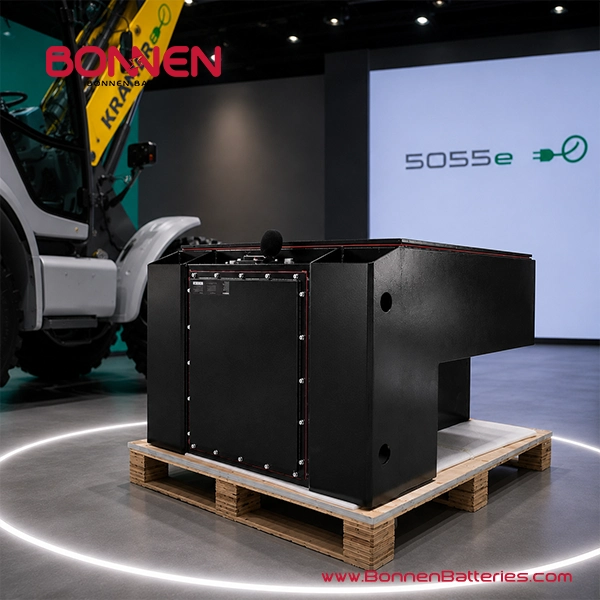
12. Case Study: 80V 560Ah Battery Solution for a Kramer 5055e Project
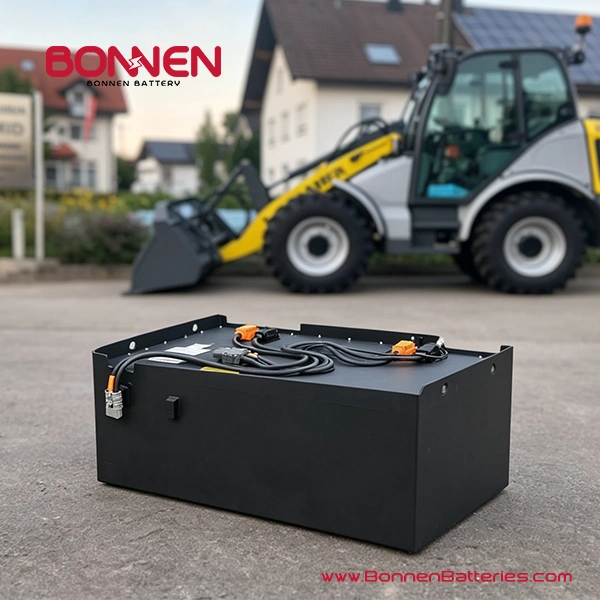
We developed an 80V 560Ah lithium battery platform for a Kramer 5055e electric wheel loader project.
The battery provides 44.8kWh of nominal energy and was designed to combine high-current output, intelligent battery management, CAN communication and jobsite protection.
This battery is a project-specific platform. It is not a universal direct replacement for every loader model.

12.1 Battery Specifications
| Item | Specification |
| Nominal voltage | 80V |
| Nominal capacity | 560Ah |
| Nominal energy | 44.8kWh |
| Maximum continuous discharge | 300A |
| Peak discharge | 500A for 3 seconds |
| Maximum continuous charging current | 200A |
| Enclosure | IP67 steel enclosure |
| Battery management | Intelligent BMS |
| Communication | CAN |
| User display | External LCD |
–
At nominal voltage, 300A corresponds to approximately 24kW of electrical power.
A 500A short peak corresponds to approximately 40kW.
These calculations are simplified. Actual power changes with battery voltage, temperature, SOC and system efficiency.
12.2 Mechanical and Electrical Integration
The project required the battery enclosure, mounting structure, connectors and cable routing to fit the machine.
The engineering work also covered charging current, CAN communication, battery monitoring and external LCD information.
The battery and loader still need to be tested as a complete system. Startup, charging, traction, hydraulic performance and fault response must all be verified.
12.3 Adapting the Platform for Other Electric Loaders
The 80V 560Ah design can be used as an engineering reference, but another loader may require a different enclosure, capacity, current rating or communication program.
Before adaptation, the new machine’s voltage range, power demand, compartment dimensions, weight limits, charger, CAN protocol, connector position and operating temperature must be evaluated together.
The goal is not to force an existing battery into another machine. The goal is to adapt the battery platform around the real application.
View the Custom 80V 560Ah Lithium Battery Solution for Kramer 5055e ⇱
The project reference does not mean that the battery is automatically compatible with every loader from the same manufacturer or with other brands.
13. FAQ
1. What is the best battery chemistry for an electric wheel loader?
LiFePO4 ⇱ is often a practical option because it offers good thermal stability, cycle life and current capability.
The final choice should still be based on the machine’s space, weight, runtime, charging rate and temperature requirements.
2. How many kWh does an electric wheel loader need?
Multiply average machine power by required active operating time.
If a loader uses an average of 20kW for four hours, it requires about 80kWh of working energy before adding reserve for losses, temperature and battery aging.
3. How do I calculate electric wheel loader battery runtime?
Divide usable battery energy by average machine power.
A battery with 40kWh of usable energy can operate for about two hours at an average demand of 20kW.
4. Is an 80V battery suitable for every electric loader?
No. The battery must match the machine’s full voltage range, current demand, charger, CAN protocol and mechanical installation.
5. Can I replace a lead-acid loader battery with lithium?
Yes, but the conversion should include voltage, charger, current, battery weight, counterbalance and mounting checks.
It should not be treated as a simple battery exchange unless the complete system has already been validated.
6. Can the original charger be reused?
Only when its charging voltage, current, communication and safety controls match the lithium battery.
A lead-acid charger should not be assumed to work with lithium.
7. Does a higher-Ah battery always provide longer runtime?
Not necessarily. Ah must be considered together with voltage. Total energy is calculated in kWh, not Ah alone.
8. Why does a loader battery need high peak current?
High current is needed during acceleration, climbing, lifting and simultaneous traction and hydraulic operation.
The battery must supply these short peaks without overheating or causing a controller undervoltage fault.
9. What IP rating is suitable for an electric construction equipment battery?
IP67 is commonly requested, but the correct requirement depends on dust, water, pressure washing, chemicals and installation position.
10. Does an electric loader battery need liquid cooling?
Not always. Liquid cooling is more likely to be required for high continuous current, frequent fast charging, hot climates or compact high-energy batteries.
11. Does the battery need heating in winter?
Heating may be required when the machine must charge or deliver high power at low temperatures.
The BMS should prevent charging below the approved cell temperature.
12. Can any CAN battery work with any electric loader?
No. The battery and loader must use the same CAN speed, message identifiers, signal definitions and startup logic.
13. How long does an electric wheel loader lithium battery last?
Service life depends on chemistry, temperature, charging rate, discharge depth and daily duty cycle.
A cycle-life number is only meaningful when the test conditions are known.
14. Can opportunity charging reduce battery size?
Yes. When charging is available during predictable breaks, the machine may require less onboard capacity.
The battery and charger must still support the planned charging rate.
15. Is a larger battery always better?
No. A larger battery increases runtime but also adds weight, cost and space requirements. The best battery is the one that meets the duty cycle with a reasonable reserve.
16. Can an automotive EV battery be used in a loader?
Usually not without major engineering changes.
The enclosure, mounting, CAN communication, cooling and current requirements may not match heavy construction equipment.
17. What information should I provide for a wheel loader battery replacement?
Provide the machine model, existing battery data, compartment drawings, voltage, current, charger, connectors, CAN protocol, required runtime and operating environment.
18. How should I compare battery quotations?
Compare usable energy, current ratings, BMS functions, communication, enclosure protection, thermal system, testing, warranty and after-sales support.
A lower price may exclude important engineering and integration work.
14. Conclusion: Choosing the Right Electric Wheel Loader Battery
The correct electric wheel loader battery must match the complete machine.
It must provide enough usable energy for the duty cycle, enough continuous and peak power for traction and hydraulics, and the correct voltage range for the controller and charger.
It must also fit the installation space, maintain machine balance, communicate with the loader and survive the real jobsite environment.
For OEMs, early cooperation between the machine and battery engineering teams reduces development risk.
For dealers, complete technical information is the fastest way to confirm whether a wheel loader battery replacement is practical.
For fleet owners, runtime, charging access, diagnostics and total cost per working hour are more important than the Ah number alone.
We develop custom lithium battery systems for electric wheel loaders and other electric construction equipment. Our engineering scope can include cell selection, enclosure design, BMS configuration, CAN communication, thermal management, high-current connectors and machine integration support.
To evaluate a project, send us the machine model, required runtime, operating voltage, continuous and peak current, available installation space, charger information, CAN protocol, operating temperature and expected quantity.
Contact us to discuss a custom electric wheel loader battery for an OEM project, dealer replacement program or equipment fleet.
Contact Bonnen Battery↓ now and let us help you power your adventures with the best lithium battery technologies.
© [Bonnen Battery] and [www.bonnenbatteries.com]. Unauthorized use and/or duplication of this material without express and written permission from this site’s author and/or owner is strictly prohibited. Excerpts and links may be used, provided that full and clear credit is given to [Bonnen Battery] and [www.bonnenbatteries.com] with appropriate and specific direction to the original content.
Heavy Equipment Lithium Batteries from Bonnen Battery
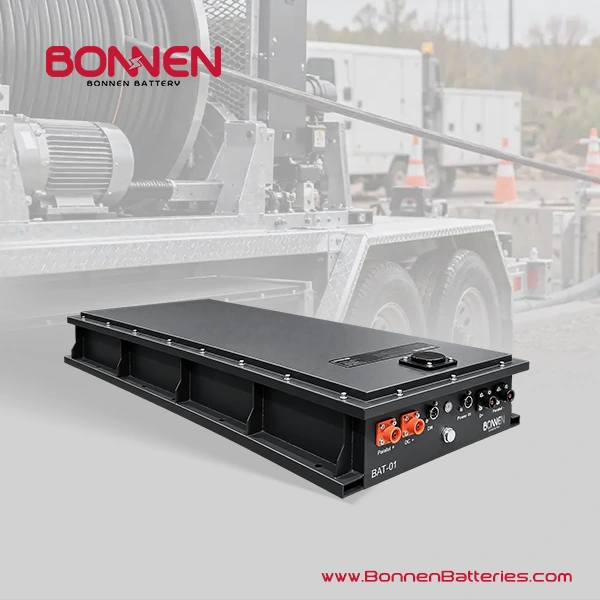
600V 614V 500Ah LiFePO4 Battery System: The Essential Heavy Equipment Lithium Battery for Construction, Agricultural, Mining, and Traction Applications

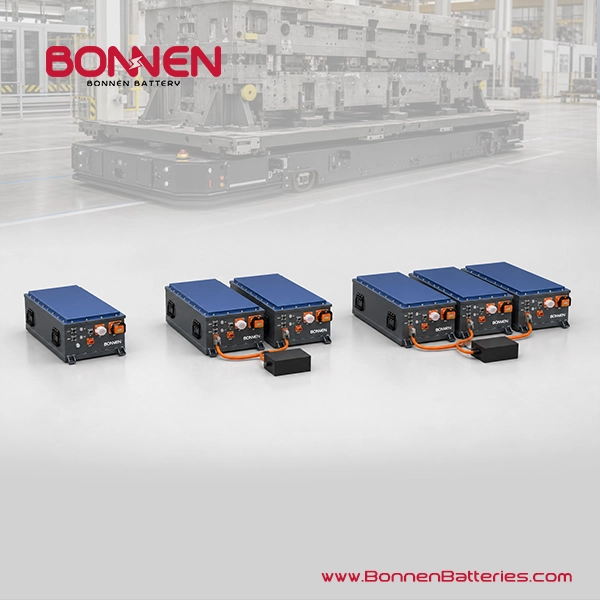
High Voltage 400V 420Ah LiFePO4 Battery System: Heavy Equipment Lithium Battery for Construction, Agricultural, Mining, and Traction Battery Packs
Application Category
Get In Touch Bonnen Battery
Xiangfeng Science Industrial Park, Changsha City, Hunan Province, China
Email: [email protected]