Last Updated on 26/10/2026 by Bonnen Battery

Condensation in Lithium Battery Packs: Causes, Risks, and Prevention Solutions
Water and high-voltage electrical equipment are a poor combination. Yet preventing water from entering a lithium battery pack is not the same as preventing condensation from forming inside it. An enclosure may resist rain, dust, and temporary immersion while still containing enough water vapor for droplets to form when internal surfaces become cold.
For OEMs, this is more than a cosmetic concern. Moisture on electrical components can reduce insulation resistance, accelerate corrosion, and contribute to intermittent faults that are difficult to diagnose. The consequences may include unexpected downtime, service costs, and reduced system reliability.
The essential principle is simple: condensation becomes possible when a surface reaches or falls below the dew point of the air around it. Effective prevention therefore requires a coordinated approach to moisture entry, enclosure design, thermal management, electrical protection, and testing—not simply a higher IP rating.
This guide explains the physics, the most common battery-pack scenarios, and the engineering decisions OEM teams should consider before a pack enters service.
1. What Causes Condensation Inside a Lithium Battery Pack?
Air contains water vapor. The amount that can remain in vapor form depends on temperature and pressure. When moist air cools sufficiently—or touches a sufficiently cold surface—some of that vapor can turn into liquid water. The relevant threshold is called the dew point.
Three values matter:
- Air temperature: the temperature of the air inside the enclosure.
- Relative humidity (RH): how close that air is to saturation at its current temperature.
- Surface temperature: the temperature of a cooling plate, metal enclosure wall, pipe, bracket, or other internal component.
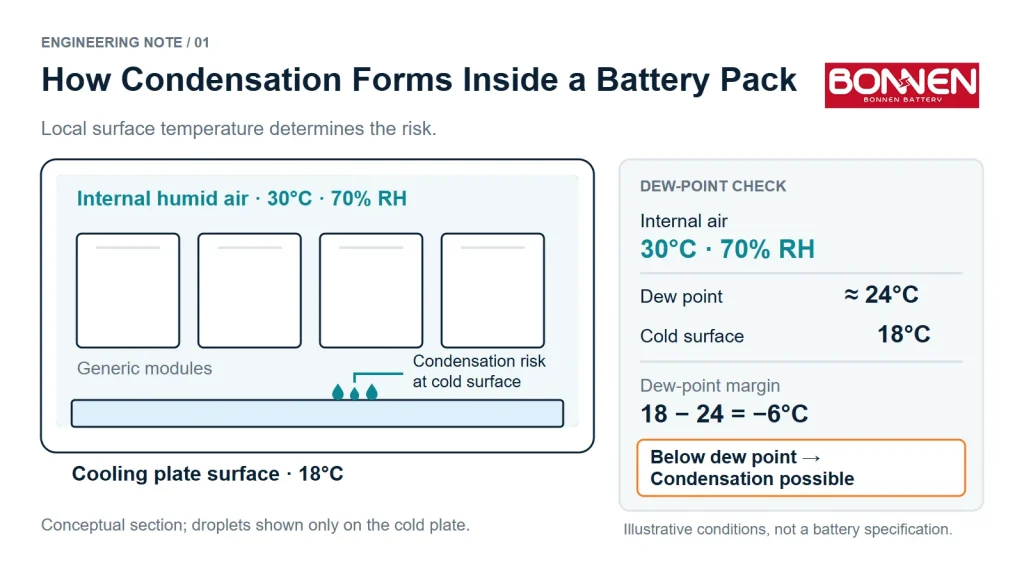
Consider a simplified engineering example. If the air inside a pack is at 30°C and 70% RH, its dew point is approximately 24°C. A liquid-cooling plate at 18°C is below that dew point, so moisture can condense on the plate when the local air and exposure conditions permit. The exact amount depends on moisture availability, duration, airflow, and changing thermal conditions.
There is no universal rule that a 10°C temperature difference is required. Even a smaller difference can be sufficient when humidity is high. Conversely, a large temperature difference may not cause condensation if the air is dry enough.
The US National Weather Service explanation of dew point and humidity ↗ is a useful reference for the underlying relationship.
Engineering takeaway: monitor the margin between the coldest relevant surface and the local dew point. That margin is more informative than ambient temperature alone.
2. How Does Moisture Get Into a Battery Pack?
Water does not have to leak through an enclosure for condensation to occur. Moisture may already be present when the pack is assembled, or it may enter gradually during its service life.
Common moisture sources include:
- Air trapped during assembly. A pack closed in a warm, humid environment can retain moisture in its internal air volume.
- Pressure-equalization vents. Some enclosure vents allow gas exchange to reduce pressure differences. Depending on the membrane and conditions, water vapor can move through them.
- Seals, cable entries, and connectors. Manufacturing variation, aging, damage, and repeated thermal movement may create moisture-entry paths.
- Maintenance and handling. Opening an enclosure or exposing it to humid conditions during service can introduce moisture.
- Liquid water ingress. A damaged seal or an unsuitable installation may allow water to enter directly. This is a different failure mode from condensation, although both can leave moisture inside the housing.
Temperature and altitude changes can also cause enclosure pressure differences, increasing the importance of correctly designed seals and vents. During a pressure reversal, the direction of gas exchange may change.
The design objective is not merely to make a housing look sealed. It is to understand how moisture can enter, where it can collect, and whether cold internal surfaces may turn vapor into liquid water.
3. Why Can Condensation Occur in an IP67 Battery Pack?
An IP67 rating is valuable, but it is often misunderstood. Under the IP code defined by IEC 60529↗, the first digit concerns protection against solid objects and dust; the second concerns water ingress under specified test conditions. IP67 is not a certification that an enclosure is permanently airtight or free of water vapor.
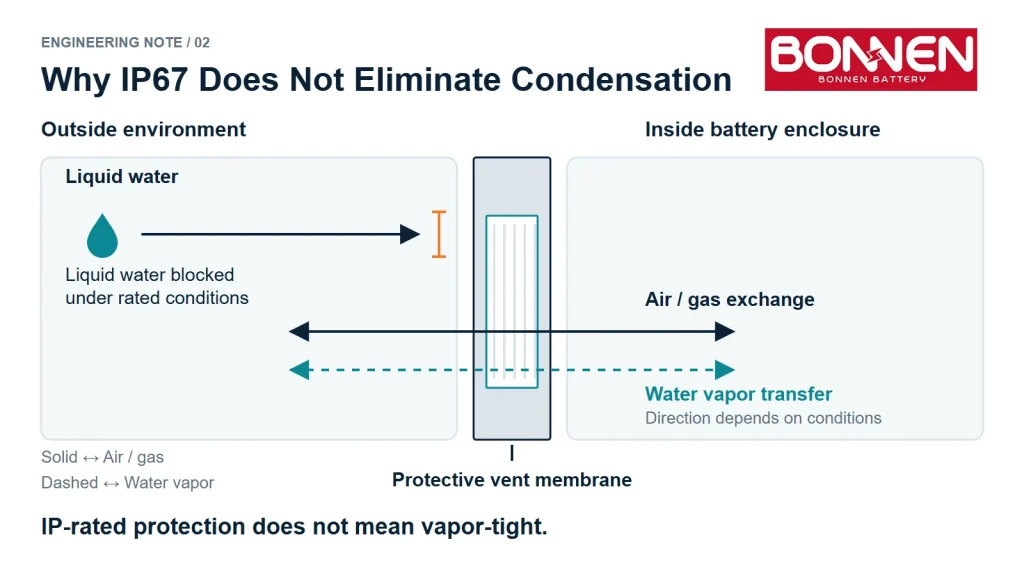
Battery enclosures also face pressure changes caused by heating, cooling, and altitude variation. Pressure-equalization vents can help manage these differences and reduce stress on seals. Many protective vents use an expanded polytetrafluoroethylene (ePTFE) membrane that can block liquid water under defined conditions while allowing gases and water vapor to pass.
This distinction matters. A membrane that blocks water droplets is not necessarily a vapor barrier. In fact, moisture diffusion through a properly selected vent may sometimes help moisture escape when conditions favor outward transport; the same principle means vapor movement cannot simply be ignored. GORE’s protective-vent FAQ ↗ describes this behavior and the practical limits of enclosure condensation control.
For an OEM design, vent selection should consider:
- Required airflow and pressure-equalization performance.
- Liquid-water and dust protection under the actual installation conditions.
- Water-vapor transport and expected humidity cycles.
- Exposure to salt spray, chemicals, dirt, or washdowns.
- Vent location, orientation, and protection from direct splashing.
- Separate safety requirements for abnormal gas release, where applicable.
IP protection, pressure equalization, and condensation prevention are related—but they are not interchangeable design requirements. The completed enclosure needs to be evaluated as a system.
4. Where Is Battery Pack Condensation Most Likely?
The risk depends on both the environment and the pack architecture. Different OEM applications may require different combinations of preventive measures.
| Application | Typical moisture or temperature challenge | Key design consideration |
|---|---|---|
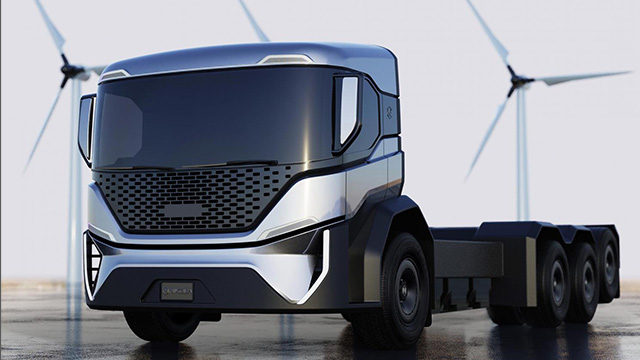
| Liquid-cooled EV battery packs | A cooling plate or fluid line can be colder than humid internal air. | Cooling control, local surface temperature, and insulation. |
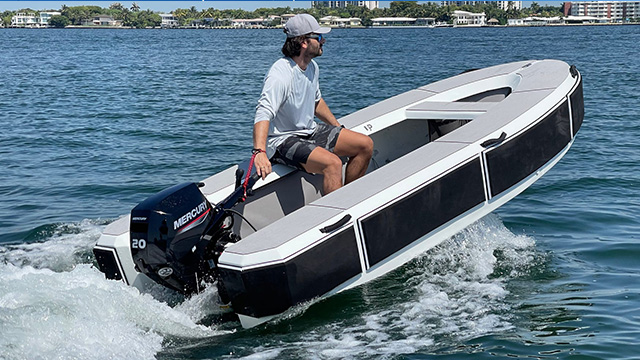
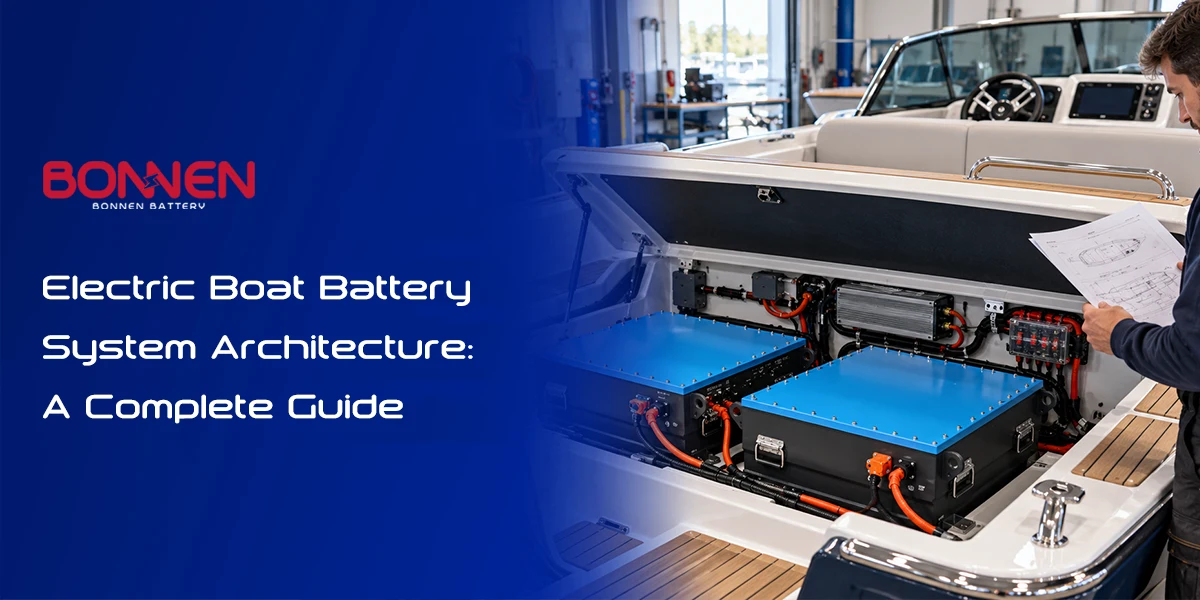
| Marine propulsion batteries | Humid air, marine spray, and repeated day–night temperature changes. | Corrosion-resistant materials, suitable connectors, sealing, and vent placement. |
| Outdoor energy storage systems | Seasonal humidity, enclosure heating and cooling, and long unattended operating periods. | Environmental control, monitoring, enclosure protection, and maintenance planning. |
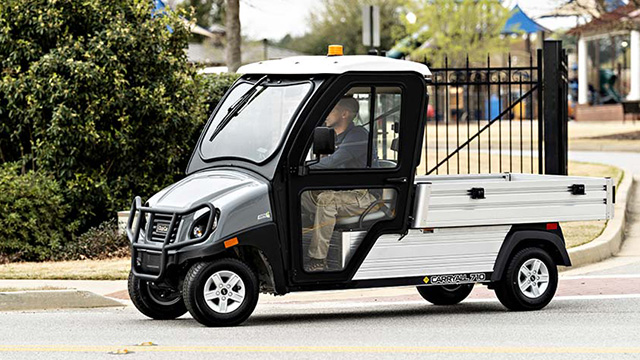
| Construction and agricultural equipment | Rain, mud, washdowns, storage outdoors, and changing workloads. | Durable cable entries, sealing, drainage management, and validation after environmental cycling. |
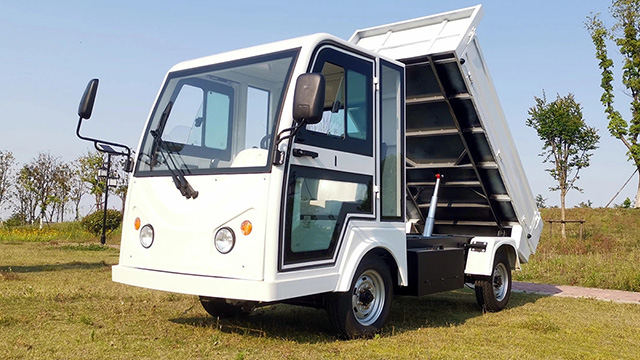
| AGV and AMR batteries | Movement between cold storage and warmer humid areas. | Temperature-transition assessment and service or charging procedures. |
For example, a battery that operates in a cold warehouse and then moves into warm, humid air may experience condensation on exposed cold surfaces. Whether moisture also condenses inside its enclosure depends on the air and moisture conditions already present there, not simply on the room temperature outside.
Similarly, a liquid-cooled pack is not automatically prone to condensation. The risk arises when moisture is available and sufficiently cold surfaces are present. The operating strategy of the cooling system can be as important as the choice of enclosure material.
OEMs working in these environments can explore the relevant application requirements for marine lithium battery systems ↗, heavy equipment battery systems ↗, and commercial and industrial energy storage ↗.
5. What Damage Can Condensation Cause?
Condensation does not mean a battery will immediately fail. The concern is that repeated or persistent moisture exposure can create electrical and material degradation over time.
Reduced insulation resistance. Water films, especially when contaminated by salts or other residues, can create unintended conductive paths across insulating surfaces. This is particularly important in higher-voltage systems with strict isolation requirements.
Corrosion of electrical connections. Busbars, terminals, connectors, fasteners, and exposed conductive surfaces may corrode. Contact resistance can rise as a result, leading to performance issues or localized heating.
PCB and sensing faults. Moisture and contamination can affect battery-management electronics, sensing circuits, and communication connectors. Symptoms may be intermittent, making diagnosis difficult after the visible moisture has evaporated.
Long-term service and maintenance costs. A battery pack may continue operating while corrosion progresses. A fault that appears months later can require enclosure opening, component replacement, and equipment downtime.
In severe cases, moisture-related electrical faults can contribute to significant safety hazards. However, it would be misleading to claim that ordinary condensation automatically causes cell degradation or thermal runaway. The outcome depends on where moisture accumulates, the electrical design, contamination, protective functions, and the nature of any resulting fault.
6. How to Prevent Condensation in Lithium Battery Packs
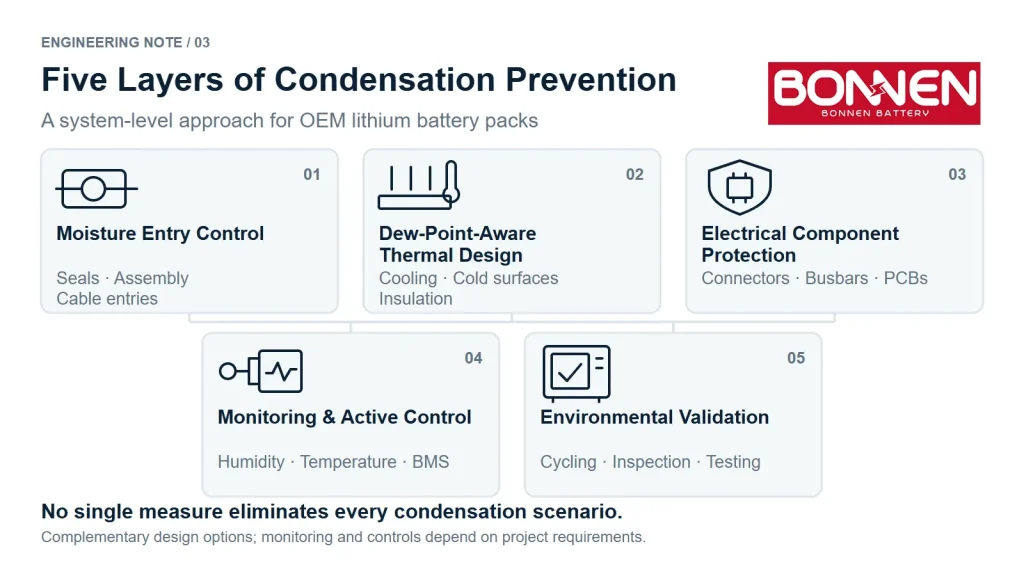
There is no universal component that eliminates condensation risk across every battery design. A robust solution uses several layers of protection, selected according to the environment, cooling architecture, electrical voltage, and maintenance expectations.
6.1 Control Moisture During Assembly and Service
The easiest moisture to manage is moisture that never enters the pack.
Manufacturers should assess humidity during relevant assembly processes, the dryness of parts and insulating materials, and the exposure of an open enclosure before final closure. Storage and maintenance procedures should also avoid leaving a cold pack open in humid air without an appropriate recovery or drying process.
Inspection of gasket surfaces, cable glands, connectors, and fastening interfaces is essential. Properly managed sealing processes can reduce the chance of direct water ingress and unwanted air exchange through unintended openings.
For procurement teams, a useful question is: What moisture-related checks are included in the supplier’s assembly and final inspection process? The answer should be supported by the supplier’s actual quality-control procedures, rather than a generic claim that the enclosure is waterproof.
6.2 Manage the Temperature of Cold Surfaces
For liquid-cooled designs, controlling the cooling-plate temperature relative to the dew point is often central to condensation prevention. Very cold coolant may be beneficial for heat removal in one operating condition but inappropriate when internal air is humid.
Possible engineering measures include adjusting coolant setpoints, limiting rapid cooldown under high-humidity conditions, monitoring representative cold surfaces, or applying suitable thermal insulation to selected pipes or components. Any insulation must be evaluated for its effect on battery heat rejection, packaging, fire and electrical safety, and long-term durability.
The correct goal is not to make the pack uniformly warm. It is to maintain safe cell temperatures and avoid unnecessary exposure of moisture-bearing air to surfaces below its dew point.
6.3 Design Seals and Vents as One Enclosure System
Gaskets, welded joints, cable penetrations, service covers, and pressure-equalization devices should be assessed together. A well-designed vent cannot compensate for an incorrectly assembled connector seal.
Water-resistant breathable membranes are useful where pressure equalization is required, but their gas and moisture transport characteristics must be understood. Installation height and location also matter: a vent positioned where water or dirt routinely collects may experience a different load from one protected by the surrounding enclosure geometry.
Some specialized designs may use internal collection features or controlled drainage as a last layer of protection. Such features require careful engineering because an added drain or valve can introduce another potential leak path and affect the intended IP performance. They should never be assumed appropriate for every sealed high-voltage pack.
6.4 Protect Electrical Components Against Residual Moisture
Even with good moisture control, critical components may need their own protection.
Depending on the design, options include insulated or covered busbars, sealed electrical connectors, appropriate PCB conformal coatings, protective barriers, and selectively potted or independently enclosed electronics. Material selection should account for voltage, heat dissipation, chemical compatibility, serviceability, and manufacturing repeatability.
For example, potting a sensitive electronic module can provide environmental protection but may make diagnosis or replacement more difficult. The protective measure should suit the component’s electrical, thermal, and maintenance requirements.
6.5 Use Desiccants Only as a Supplementary Measure
Silica gel and other moisture-absorbing materials can reduce the water-vapor load inside some enclosed spaces. They may be useful when the enclosure volume, humidity exposure, service interval, and desiccant capacity have been evaluated.
However, a desiccant is not a substitute for sound sealing and thermal design. Its capacity is finite, it may become saturated, and its effectiveness depends on temperature and moisture movement. There is also no universal relative-humidity target, such as 40%–80%, that guarantees a pack will remain free of condensation. The relevant question is whether the coldest surfaces remain sufficiently above the dew point under the expected conditions.
6.6 Add Monitoring and Active Control Where Justified
For some systems, passive protection alone may not provide enough assurance. Temperature and humidity sensing can support a more informed control strategy.
A practical indicator is the dew-point margin:
Dew-point margin = Minimum relevant surface temperature − Local air dew-point temperature
When this margin becomes small, a properly designed controller may modify cooling operation, activate an approved heating function, or issue a diagnostic warning. The threshold should account for sensor accuracy, placement, response time, and thermal transients; there is no single universal safe margin for all packs.
Internal airflow can reduce local temperature differences in some architectures, but a fan does not remove moisture by itself. If it moves humid air across a colder surface, condensation may still occur. Fans should therefore be treated as part of an engineered thermal and moisture-control strategy, not as a stand-alone cure.
The BMS can participate in monitoring and protective control when the necessary sensors, software, and interfaces are included in the system design. Cell-temperature readings alone are not enough to calculate the dew point of internal air.
7. An Example of System-Level Condensation Risk Assessment
Imagine an OEM developing a battery pack for an electric workboat. The vessel may operate in humid coastal air, experience cool nights, and use a compact enclosure with limited space for electronics and cables. If liquid cooling is included, the design must also consider the temperature of the cooling circuit during startup and continuous operation.
An engineering review would examine several connected questions:
- How much moisture might remain inside the enclosure after assembly?
- Can vapor enter or leave through a vent under realistic temperature cycles?
- Which components are likely to reach the lowest surface temperatures?
- Could any resulting droplets reach sensitive electrical parts?
- What sealing, insulation, monitoring, and protective measures are practical?
- How will the chosen design be verified after temperature and humidity cycling?
The same thinking applies to an outdoor tractor battery or a stationary storage system, although the environmental loads and packaging constraints differ. This is why condensation prevention should begin during battery-pack specification, not after visible droplets appear in a prototype.
8. How Should OEMs Validate Condensation Protection?
A credible moisture-management design needs appropriate testing. Visual appearance and an IP label alone cannot demonstrate performance across repeated environmental cycles.
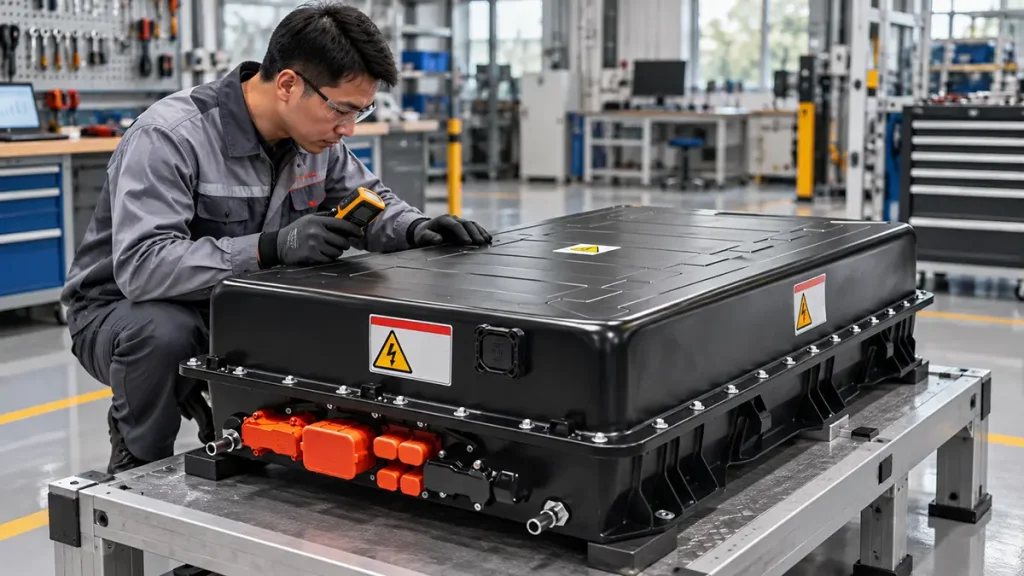
Possible validation activities include:
- Temperature-and-humidity cycling: expose representative equipment to conditions reflecting realistic storage, transport, and use, with acceptance criteria defined beforehand.
- Enclosure ingress and sealing tests: assess the complete assembled housing, including connectors and vents, against project requirements.
- Insulation and electrical checks: compare insulation resistance and relevant electrical functions before, during where appropriate, and after testing.
- Functional monitoring: look for unintended BMS resets, sensor errors, isolation alarms, or communication interruptions.
- Post-test inspection: examine likely cold surfaces, PCB areas, terminals, cable entries, and concealed collection points for moisture or corrosion.
IEC 60068-2-30:2025 ↗ provides a standardized cyclic damp-heat test method involving high humidity and temperature changes that generally produce surface condensation. IEC 60068-2-38:2021 ↗ addresses composite temperature/humidity cycling, primarily for component-type specimens. It does not apply to specimens energized throughout the entire test. Applicability, test severity, and operating state must be determined for the product and project.
An IEC 60068 test should not be described as proof of complete battery-system safety, and an IP67 result does not replace humidity-cycle evaluation. OEMs should request clearly defined acceptance criteria and actual test records for any claimed qualification.
9. OEM Checklist: Questions to Ask Before Selecting a Battery Pack
Before finalizing a custom lithium battery design, confirm the following with your battery supplier:
- What are the minimum and maximum ambient operating temperatures?
- What are the expected relative-humidity and condensation exposure conditions?
- Will the pack move between cold and warm environments?
- Is the system air-cooled, liquid-cooled, or passively cooled?
- What is the lowest expected temperature of any internal component or surface?
- Is an IP rating required, and which complete assembly will be tested?
- Does the enclosure need a pressure-equalization vent?
- Are marine spray, chemicals, pressure washing, mud, or dust part of normal service?
- How are high-voltage connections, the BMS, and other sensitive electronics protected?
- Is humidity or dew-point monitoring necessary for the application?
- What environmental and electrical validation tests are required?
- What inspection or maintenance is practical after installation?
The more clearly these conditions are defined at the RFQ stage, the easier it is to make an informed comparison between competing battery proposals. A lower quoted price does not necessarily include the same enclosure materials, electrical protection, environmental controls, or validation scope.
10. Building Moisture Protection Into a Custom OEM Battery Project
There is no single waterproofing feature that resolves every condensation scenario. The most reliable approach considers environmental exposure, cooling performance, electrical insulation, pressure management, manufacturing controls, and verification as parts of one battery system.
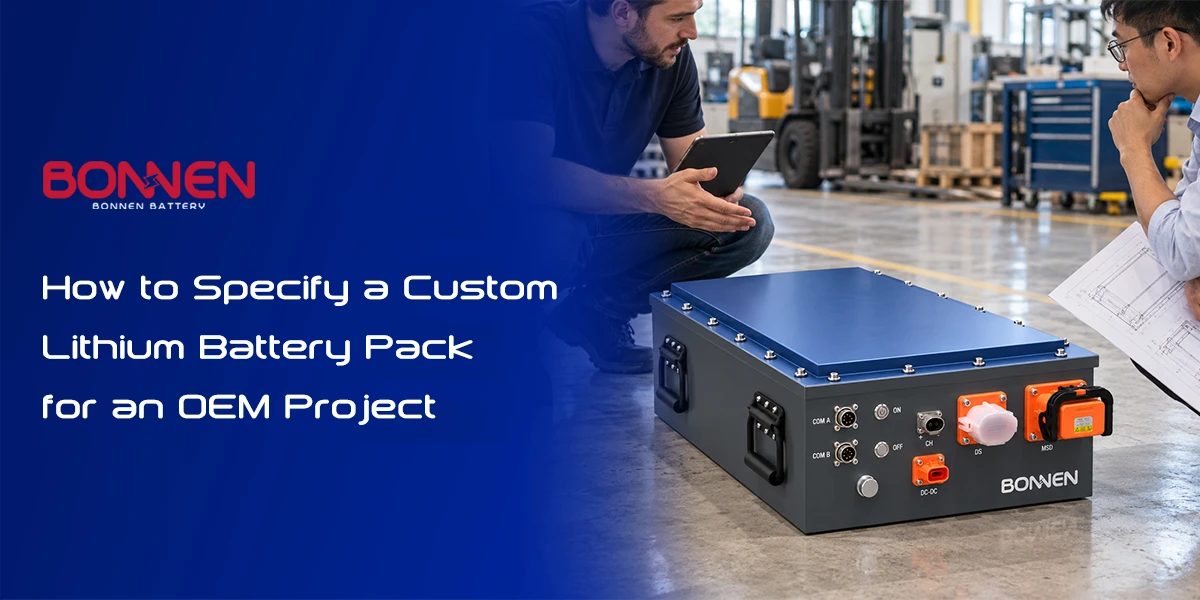
For OEMs designing electric vehicles, boats, industrial machines, robots, or energy storage equipment, these requirements belong in the initial battery specification alongside voltage, capacity, discharge current, dimensions, communications, and charging needs.
Bonnen Battery develops custom lithium battery pack solutions for OEM applications ↗ based on equipment and integration requirements. If your project involves high humidity, liquid cooling, outdoor operation, or frequent temperature changes, share those conditions early so the appropriate enclosure and system-level protection options can be evaluated during design.
Planning a custom lithium battery pack? Contact Bonnen Battery with your application, battery specifications, environmental conditions, and installation constraints to discuss a suitable engineering approach.
11. FAQ
1. Can condensation form inside an IP67 lithium battery pack?
Yes. IP67 addresses dust ingress and water protection under defined test conditions; it does not guarantee that internal air is dry or that water vapor cannot be present. Moisture can be trapped during assembly or enter over time through permitted vapor transmission or unintended leakage paths. If an internal surface becomes colder than the local air’s dew point, condensation may occur even though the enclosure is designed for IP67 performance.
2. What is the dew point in a lithium battery enclosure?
The dew point is the temperature at which air with a given moisture content reaches saturation and may begin depositing liquid water on a sufficiently cold surface. It depends on temperature, relative humidity, and pressure. For battery engineers, the important comparison is between the local dew point and the temperature of cooling plates, enclosure walls, pipes, or other components—not simply the difference between indoor and outdoor air temperatures.
3. Is condensation more common in liquid-cooled battery packs?
Liquid cooling can create cold surfaces that increase condensation risk when humid air is present, particularly if a cooling plate or fluid line operates below the local dew point. However, it is not inevitable in every liquid-cooled system. Coolant-temperature control, moisture management, insulation where appropriate, enclosure design, and validated operating conditions can significantly influence the outcome.
4. Does a battery pressure-equalization vent prevent condensation?
Not by itself. A correctly selected vent helps balance pressure while providing specified protection against liquid water and particles. Some vent membranes also permit water-vapor transport, which means they are not equivalent to hermetic vapor barriers. Whether a vent reduces or increases moisture exposure depends on the design and environmental conditions. It should be evaluated together with sealing, operating temperatures, and the enclosure’s expected humidity cycles.
5. Can silica gel completely solve moisture problems inside a battery pack?
No. Silica gel can absorb a limited quantity of moisture and may be useful as a supplementary measure in a suitably designed enclosure. Its capacity can be exhausted, and the amount required depends on enclosure volume, moisture ingress, temperature, and service life. It cannot compensate for poor seals, direct water ingress, or an excessively cold internal surface without suitable thermal management.
6. Can a heater prevent battery pack condensation?
A suitably controlled heater may help maintain selected surfaces above the dew point or manage temperature transitions, but it must be assessed for energy consumption, cell-temperature limits, thermal uniformity, and electrical safety. Heating alone does not remove water from the enclosure. The correct strategy depends on the source of moisture, the components at risk, and the operating conditions of the whole battery system.
7. Will an internal fan stop condensation from forming?
An internal fan may improve temperature uniformity and reduce localized stagnant zones, but it does not dehumidify the air. If the fan circulates humid air over a surface below its dew point, droplets can still form. Fan placement and control should therefore be evaluated with thermal analysis, humidity conditions, and component locations rather than treated as a guaranteed condensation-prevention solution.
8. Are LiFePO4 batteries less affected by condensation than NMC batteries?
Condensation risk inside a pack is governed primarily by moisture, surface temperature, enclosure design, and electrical protection rather than the choice of LiFePO4 (LFP) or nickel manganese cobalt (NMC) cell chemistry alone. Both technologies can be installed in packs containing busbars, connectors, electronics, and insulation vulnerable to moisture-related problems. The appropriate prevention design depends on the complete pack architecture and application.
9. What should an OEM do if moisture is discovered inside a battery pack?
Treat it as a potential electrical safety issue. Follow the manufacturer’s shutdown, isolation, and service procedures; do not open or energize a suspect high-voltage pack without appropriate qualified personnel and controls. The inspection should establish whether the moisture came from condensation, direct ingress, cooling-system leakage, or another source, and assess insulation, connectors, electronics, and corrosion before any decision to return the pack to service.
10. What tests should an OEM request for a battery pack used in humid environments?
The test plan should reflect the intended product and operating conditions. Depending on the application, it may include cyclic damp-heat exposure, thermal cycling, assembled-enclosure ingress protection, insulation-resistance checks, functional operation, and post-test inspection for corrosion or moisture collection. Relevant IEC environmental test methods can provide useful procedures, but the OEM and supplier must agree on test severity, acceptance criteria, sample configuration, and documented results.
Contact Bonnen Battery↓ now and let us help you power your adventures with the best Lithium Battery System technologies.
© [Bonnen Battery] and [www.bonnenbatteries.com]. Unauthorized use and/or duplication of this material without express and written permission from this site’s author and/or owner is strictly prohibited. Excerpts and links may be used, provided that full and clear credit is given to [Bonnen Battery] and [www.bonnenbatteries.com] with appropriate and specific direction to the original content.